Thursday, November 1, 2018

Orphan Parade: Cleora Schlomer Heagy


Cleora Schlomer, college yearbook portrait, ca.
My great-grandmother Cleora and her little brother Ralph lived in an orphanage for three years.  The orphanage was called St. Thomas, and it was run by Catholic nuns--the Sisters of Providence-- in Great Falls, Montana, est. 1909. 
St. Thomas in the 1930s, more than a decade after Cleora and her brother lived there.
 I don't think this building is still standing--currently the St. Thomas orphanage is in a different building and is called the St. Thomas Children and Family Center, operating as more of a daycare.

Originally, though, the orphanage was designed to " care for children from broken homes, orphans or children in need of care for at least a year".   Also "it was a school and a boarding house for children who lived in rural areas, and a safe environment for children whose parents were faced with hard times." 2  In its early years, most of the children were under the age of 12.  3 

Cleora and Ralph would have fit most of the above descriptions.  They were partly orphaned in 1914 when their mother, Frieda, died of appendicitis at age 29.  4  Cleora would have been six and Ralph five.  The family was living in Great Falls, MT, and since both parents had immigrated from Germany on their own,5 they really had no extended family support.  Apparently John, the father, tried to manage with the children at home for a few years, but then admitted them to St. Thomas in 1918.  6
https://www.providence.org/about/providence-archives/past-forward-newsletter/winter-2001/historical-photos-from-st-thomas-orphanage
So what changed in 1918?   We aren't entirely sure why John would decide to put his children in the orphanage (this is pre-Depression era), but we do know that John worked at the American Brewery in Great Falls.  In 1918, the American Brewery was closed because of the Prohibition (which had passed "early" in Montana on a November 1916 referendum, to go into effect Dec. 31, 1918--they saw the writing on the wall.)
Most likely, John was scrambling for work.  By 1920 the census pegs him as a "laborer" for a brewery, along with several others on his street.8  I wonder if he is not listed as a "brewer" because technically they would not have been brewing.   An article in the Smithsonian Magazine explains that several breweries survived prohibition by retooling or redirecting their equipment to make such concoctions as:  ice cream, cheese, dyes, soft drinks, near-beer, and legal malt extract (which customers bought with a wink, to use for "baking" at home--definitely not home-brewed beer). 9 I don't know which brewing company John moved to or what products they were making.

In any case, by June 1921 John retrieved his children. 9  Cleora's daughter-in-law Bev Heagy thinks that he might have finally brought them home because Cleora would have been thirteen and old enough to cook and keep house.  "She cooked like a nun."
The St. Thomas Orphans riding in a parade in Great Falls the year after Cleora and Ralph left.  Very likely this was an annual event, so Cleora and Ralph had probably been on parade a few times.  These are most likely their friends.
 Cleora's son Ebert says that his mother did not really ever talk about her orphanage experience, good or bad.   She remained Catholic and wore a little crucifix (but didn't drive or ask for ANYTHING, and her lunkhead sons never offered to chauffeur her to attend Mass, says Bev.) So, hopefully it was a good experience, especially in contrast to her interactions with her father John, which were at times angry/drunk/and probably abusive.  Sometimes if she walked home from school and he was in bad mood, she would hide out by the railroad cars.  Luckily Cleora was allowed to attend Paris Gibson High School and then received her teaching certificate from Dillon Normal (teaching) College.  She eventually married into the Heagy family, who were an easier-going, fun-loving bunch.

A page from Cleora's Dillon Yearbook.  "Chinook" is, I believe, the name of the house, not the Montana town.  I bet the dorm life had some comparisons to the orphanage--minus the nuns.  I also love how identical their hair-dos are.  Just like if you were to walk down the halls of a high school today.

Little brother Ralph also escaped the abuse a little more dramatically by running away and legally changing his name to John Johnson (interestingly, the same first name as his Dad?!).  He served in the army in World War II, married, and lived to the ripe old age of 92.  Here is a copy of his obituary.  Ebert thinks Ralph/John looks a lot like John Sr.


As far as Cleora's relationship with her father, most likely it was moderated by the presence of her husband Charlie, who built a house next door to the Schlomers (734 14th St SW), where the couple remained in close proximity.  Cleora's son Ebert was unsure if Charlie first built the house and then courted Cleora or the other way around.
John, Cleora, and John's wife Josephine?
  The house that (I believe) was John's (804 14th st) was recently up for rent, described as 

Vintage home on an acre with Sun River in back! Room for horses!Room for horses and gardening. Located on the Sun River. Very private, rural living within the city limits.  Home is next door to 734 14th St SW, and backyard faces the Sun River levee. Property has river access, but no dock.  10


 John remarried, divorced, remarried the same gal, and when she was gone married one more time.  He did not live out his days in the Great Falls house, but lived in California and Oregon where he died in 1962.11


Sources:
1.  Montana Historical Society Research Center, Montana History Compass, "Montana Orphanages", ed. Barbara Pepper Rotness, last viewed June 2018, www.http://mthistory.pbworks.com/w/page/100755328/Subject%20Guides%3A%20Genealogy%20Guide%3A%20Montana%20Orphanages
2. http://www.stthomaskids.org/about/history
3.  https://www.providence.org/about/providence-archives/past-forward-newsletter/winter-2001/historical-photos-from-st-thomas-orphanage
4.   Death Certificate for Freida Bornemann Schlomer, #4516, Great Falls, Cascade, Montana, Bureau of Vital Statistics.
5.  "Maryland, Baltimore Passenger Lists, 1820-1948," database with images, FamilySearch (https://familysearch.org/ark:/61903/1:1:2CSK-X98 : 15 March 2018), Frieda Bornemann, 1906; citing Immigration, Baltimore, Baltimore, Maryland, United States, NARA microfilm publications M255, M596, and T844 (Washington, D.C.: National Archives and Records Administration, n.d.); FHL film 1,454,840. John's ship manifest has been found (as he reported on his naturalization record) but somehow his name is not on it.  It is assumed that he traveled alone since he does not appear with any family members in census or other records, and his known siblings remained in Germany
6.  Correspondence from St. Thomas archives, in possession of Jaclyn Day, SF, Utah.
7.  Mortuary invoice for Mrs. Freida Schlomer, copy in possession of Jaclyn Day, SF, Utah.  John's place of employment is listed as American Brewery Co. 
8.   "United States Census, 1920," database with images, FamilySearch (https://familysearch.org/ark:/61903/1:1:M83J-QKX : accessed 1 November 2018), John Schloma, Great Falls Ward 5, Cascade, Montana, United States; citing ED 32, sheet 12B, line 86, family 281, NARA microfilm publication T625 (Washington D.C.: National Archives and Records Administration, 1992), roll 968; FHL microfilm 1,820,968.
9.   www.smithsonianmag.com/smart-news/how-some-breweries-survived-prohibition-180962754/
10.   https://greatfalls.craigslist.org/apa/d/vintage-home-on-an-acre-with/6721679902.html
11.   "Oregon Death Index, 1903-1998," database, FamilySearch (https://familysearch.org/ark:/61903/1:1:VZH5-GBR : 11 December 2014), John Schlomer, 25 Jan 1962; from "Oregon, Death Index, 1898-2008," database and images, Ancestry (http://www.ancestry.com : 2000); citing Coos, Oregon, certificate number 152, Oregon State Archives and Records Center, Salem.

Other insights/lore obtained from interviews in 2018 with Cleora's son and daughter-in-law, Ebert and Bev Heagy of Montana. 

Sunday, August 5, 2018

Let's Go Camping with the Van De Riets

Harry and Bess loved the great outdoors and were troopers about teaching their kids to do the same.  Especially Bess (was a trooper!)  She eventually had nine babies and was still game for hi-jinks like this!  So sit back and imagine yourself in the mid-1920s, Montana--the Big Sky Country.  What do you do for fun, with a passel of kids?

It's the Griswold family vacation!  LOVE the tent tied to the fender.  Wish I could hold my baby in the backseat.
Harry's mother was an amateur photographer with her own darkroom.  His brother Hi was a war photographer (cRAZY!) who took shots across enemy lines in WWI.  Harry picked up a few skills and so we have an inordinate amount of photographs of this particular family with their cute kiddos.  Of course, I always think My Grandma LaVonne is the cutest.
Not sure if this is dinner?  You can see a Dutch oven on the fire and a tent to the left.  Back before established campgrounds with picnic tables, firepits and outhouses.  (These pictures were labelled with LaVonne when she was still living, but I wonder if the baby above is actually her older brother Ray.)
A later trip, but you can see what they liked to do while they were out in the woods.  There are many fishing pictures in the collection.

LOVE this picture of Grandma Bess, wading with her little boys.  She easily could kept her skirts on and sat with the baby, but here she is cooling her feet.  What a great mom.

Of course, this was something Harry had already discovered she had a weakness for.  (Aren't they so darling?)

This photo appears to be behind a house, not camping, but I wonder if they brought the dogs, too?

They liked to go with their extended family, as well it appears.
What a great Twenties-era sundress!  Perfect for a day in the great outdoors.  I think she is leaning against the tire.  She needed a camp chair.
.
Sometimes they went to the lake.
Harry with his string of fish. Later in life, semi-retired, I think he worked as a game checker in Augusta.  Are all these fish regulation size?
Not sure where this is, but it looks like fun.


Fishing with cousins means you get a LOT of fish.  (These are Harry's sister Marie's kids, the Schnee's, sitting with Harry and Jack.)

The cousins lived close to Glacier park.  At least I think that's where this is.

Jack, Ray, Harry and LaVonne.  Loving the overalls.
Once again, this may be baby Ray, not LaVonne.

Ok, there's the dog.
The camping and fishing remained an important part of the Van De Riet children's lives and with their own families.
Here is LaVonne as a young mother.  Hubby Jack Haynes and sister Normie Van De Riet are behind the table.  (They have picnic tables by now.)


LaVonne with a string of fish of her own.

And LaVonne and her hubby Jack took their grandchildren fishing, and to the mountains, and to the lakes.


And it culminates in a campground of "our" own!  I remember this night. (I'm in the striped sleeves). This is a great place, right close to the airfield.  Maybe i will leave this post a little open ended, and add some more camping and fishing through the Van De Riet generations as I come across them, so Check Back Later for more goodies!


Friday, November 4, 2016

The Whaler's Bribe: Patriot Nathan Coffin

  This is a new Revolutionary War ancestor I came across this summer.  So inspiring!

I won't bore you with the exciting (to me) research processes that led me to this grandfather, (you can ask me later if we're ever stuck on a long car ride together with no radio) just trust me that he's on our tree and enjoy his story.  Here is how I am related.

Me; Mom; Grandpa Heagy; C.A.S. Heagy; Martha J. Cooper; Thomas B. Cooper; Emily Coffin; George Coffin; Nathan Coffin.

Our story begins in Nantucket.
"Nantucket Sleigh Ride" refers to the whale pulling the boat after it has been harpooned.

Nantucket is famous for its whaling, sea going families.  It was recently portrayed in the move "In the Heart of the Sea".  The movie is based on a nonfiction book, so the names used were authentic--and there was a Mr. Coffin on the ship!  (Even if he was a villain.)

Nantucket was in a unique geographical position--very close to the migrating whales.  An incredible industry began, bringing a new source of light to America.
For almost a hundred and fifty years — from the early 1700s to the 1840s — Nantucket was the whaling capital of the world. As Melville wrote in Moby-Dick: "Thus have these . . . Nantucketers overrun and conquered the watery world like so many Alexanders."--from Nantucket Historical Association
Our Coffin family was a proud, prominent part of this tight-knit community.  I say tight-knit for multiple reasons.  (Yes, intermarrying was a big reason.)  The population was small, like a small town but much closer because of the terrible dangers faced by its whalers.  I imagine the women were also incredibly close as they were left alone for years on end.  It was probably almost like a military situation--bands of brothers with their wives weeping at home together.  Anyway, anyone ever heard of a widow's walk?
It's that rooftop balcony that the wives would watch for the return of their sailors.  That was their life.  The women probably hated it but the menfolk LOVED it.  Such an exciting lifestyle.  Stay with me, this is an important part of the story.

I knew that the Coffins were Nantucket whalers--that part of the story was passed down--but I was surprised to find records of our grandmother Emily Coffin born in Easton Co. New York.  Very much inland.  So what happened?  I didn't think I would ever know the reason for the family's migration, but I found it, and it is a much more dramatic story than I would have ever guessed.

Emily's cousin Charles Marshall happened to be a rich merchant mariner and an important statesman heavily involved with the early GOP.  When he died, his obit was printed in the New York Times, he was memorialized during Congress, and also a small biography was written about him and his forebears.  Huzzah! Apparently the authors of the memorial interviewed his surviving whaler brothers, and they tell what happened to our Nantucket Coffin family.

"The Revolutionary War...greatly interfered with the prosecution of the Nantucket whale-fisheries.  The English men-of-war, cruising off the American coast, would often intercept the vessels seeking to make their way into port laden with the fruits of long years of labor and exposure in distant seas, while to send a ship refitted and equipped on an outward voyage was to risk its speedy capture.  The hardy islanders, thus blockaded
British Man-of-War
on the side of the ocean by an enemy whom they had no means of resisting, turned their eyes to the main-land.  New England, from which their ancestors had been driven by persecution a century before, [I'm guessing because they were Quakers?] was not thought of as an asylum, but the border counties of new York offered a good climate, and cheap land, capable of being easily cleared of the forest and reduced to cultivation.  In 1779, a number of families broke up at Nantucket.... They took up [in] what is now the richest part of Washington County [NY]." 

That was the generic story of the community.  Now on to our grandfather Nathan Coffin's particular adventure.

"Nathan Coffin had been a contemporary, perhaps a shipmate, of [Charles' other grandfather] Benjamin Marshall.  After a life of adventure on the ocean, he had set out, in an ox-team, with his wife, his son, and his daughters, for a new home in a northern wilderness.  He had experienced something more than mere apprehension of peril from British cruisers.  Before the Revolution, he had succeeded in saving from the earnings of some prosperous voyages a moderate sum of money, which he put into a common stock with some of his Nantucket neighbors, and, going to London, engaged with them in the venture of chartering a small vessel, which they freighted with a cargo of assorted merchandise for a home port.  The war was already imminent, and, fearing trouble, the copartners procured a permit from the English admiralty authorizing them to enter any port on the American coast.

They sailed with their cargo and crossed the ocean safely, but as they neared Nantucket were boarded by an English man-of-war; their pass was disregarded; [the OUTRAGE!] their vessel and cargo was seized as lawful prize, and the whole company, stripped of everything, were taken to Martinique, and from there to New York, where they were thrown into the prison-ship "Jersey," of infamous memory". 

About this prison-ship Jersey.  I knew the British liked to use old rotten, unseaworthy hulks as prisons because their prisons on land were always overflowing.   The HMS Jersey is pretty well known and there is a lot of information about her.  She was built in 1736, fought in Colombia against the Spaniards in 1739, badly damaged in battle in 1745, repaired and took part in the Battle of Lagos in 1759.  By 1771 it was hulked and converted to a hospital ship in Wallabout Bay, New York.  Then when the war began the British used her as a prison ship for captured Continental Army soldiers, "making her infamous due to the harsh conditions in which the prisoners were kept.  Thousands of men were crammed below decks where there was no natural light or fresh air and few provisions for the sick and hungry...with brutal mistreatment by the British guards becoming fairly common.  As many as eight corpses a day were buried from the Jersey alone before the British surrendered ...in 1781.  When the British evacuated New York at the end of 1783, Jersey was abandoned and burnt in the harbour, having had approximately 8,000 prisoners on board.  ...Some 11,000 prisoners died aboard the prison ships over the course of the war, many from disease or malnutrition.  Many of these were inmates of the notorious HMS Jersey, which earned the nickname "Hell" for its inhumane conditions and the obscenely high death rate of its prisoners.

There are some surviving accounts, this one from Robert Sheffield of Connecticut, who was on a British prison ship during the Revolution, thought not necessarily the Jersey.
"The heat was so intense that (the hot sun shining all day on deck) they were all naked, which also served the well to get rid of vermin, but the sick were eaten up alive.  Their sickly countenances, and ghastly looks were truly horrible; some swearing and blaspheming; others crying, praying, and wringing their hands; and stalking about like ghosts; others delirious, raving and storming, --all panting for breath; some dead, and corrupting  the air was so foul that at times a lamp could not be kept burning, by reason of which the bodies were not missed until they had been dead ten days."
Back to Nathan Coffin, prison ship survivor.

"In this wretched hulk Nathan Coffin lay for eleven months, sharing the privations and insults which made so many martyrs to the cruelties which disgraced the British occupation of our harbor.  The vessel was anchored in the East River, and from time to time was visited by a lieutenant of the British navy, who approached many of the prisoners with offers of commissions in His Majesty's service, provided they would renounce the cause of the rebels, and give in the adhesion to the crown.

To Nathan Coffin, who was an able and experienced shipmaster, he made liberal promises, tendering him a command and large pay.  The reply of the stout-hearted sailor contained the whole spirit of the struggle for independence:  'You may hang me to the yard-arm of your frigate, but do not ask me to turn traitor to my country!'  Isaac Coffin, an own cousin of Nathan, also an able seaman, but lacking the patriotic ardor of his kinsman, yielded to the tempting offers of a commission, rose to the highest naval rank in the British service, and figures on its rolls as Admiral Sir Isaac Coffin.  [Isaac was not a prisoner when offered the commission, he was simply a loyalist already working for the navy.  He was also not a first cousin, just a kinsman, from Boston, not Nantucket.  I fact checked.] His loyal cousin, plain Nathan Coffin, never forgave what he deemed desertion from the flag and treason against the government of his native country.  He persisted in his own choice of steadfast adhesion to the doubtful cause of the colonists, and, after suffering the privations of the prison-ship for eleven months, was at last released.  He at once made his way to Nantucket, and shortly afterward, as we have seen, joined the party of emigrants to the colony in northern New York."
Nathan gave up his beloved whaling and "spent the rest of his life as a farmer," although some of his sons and grandsons eventually continued the seafaring profession. Nathan lived until 1813, the midst of the War of 1812, and some of his last words showed "the fervent hope that there 'might be an honorable peace, or none.'"

There is actually a bit of an appendix to this story, concerning that "traitor" Sir Isaac Coffin and how he made good.

During the War of 1812, Nathan's son Charles (our g-uncle), was chief mate on the Melpomene.  When they were on route to Amsterdam the ship received some damage and actually had to put into Portsmouth England for repairs.  That would be tricky during war!  Especially in 1812 when the Brits were "practising the impressment of American seamen".  Anyway, a British ship docked next to them and there was a bit of an altercation that ended with Charles throwing a young British lieutenant off the ship.  Charles was imprisoned and then arraigned before the admiral and his officers.
Admiral Isaac Coffin

The admiral asked the young man his name.  He answered, "Charles Coffin."  "Whose son are you?" asked the admiral.  "Nathan Coffin's."  the admiral hesitated a moment, and then remanded the prisoner, saying that he could not be tried until the next day.  The same afternoon the admiral came on board the guard-ship and sent for the prisoner.  He said to him privately: "I am Admiral Coffin, your father's own cousin.  You have thrown overboard one of His Majesty's officers, and there is nothing to prevent your swinging from the yard-arm, but I will try to clear you."  He then instructed his belligerent kinsman to express regret for his hasty conduct, and to make what reparation he could by apologizing for his rashness and violence, and to leave the rest to him.  The mate readily acquiesced, and, after appearing the second time before his judge, was sent back to his ship unharmed.  Afterward the admiral paid him a visit, and invited him to dinner.  Doubtless he hoped that the part he had taken to protect his gallant young kinsman would prompt kindly thoughts toward him in the heart of old Nathan Coffin."
(Isaac later contributed funds to establish the Coffin School back on Nantucket Island, with a mission to "promote decency and morality".)


Sources
 

Butler, William Allen. (1867). Memorial of Charles H. Marshall. D. Appleton. pp. 13–.


Oldham, Elizabeth.  "Brief History of Nantucket".  Nantucket Historical Association website, 2016.

"HMS Jersey".  Wikipedia.org. October 2016.

 www.nantucketpreservation.org. November 2016.

"Sir Isaac Coffin, 1st Baronet".  Wikipedia.org. November 2016.

Tuesday, May 31, 2016

Two Silver Pistols and a Blacksnake Whip: Daniel Newell Drake, part two

At the end of a very long train ride from Simms, Montana to Ogden, Utah, a devastated little boy (he had lost his Cracker Jacks pea-shooter on the train) went to meet his grandfather for the very first time in his memory.  His grandfather was Daniel Newell Drake the third, and he was dead in a coffin.

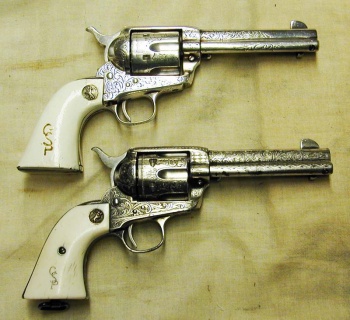
The dead man had white hair, a large mustache, and something especially wonderful: two six-shooters hanging prominently on the wall next to the coffin.  There were Colt 45s, pearl handled and nickel or silver plated.
For example, these are General Patton's, one is original, one was made for a movie.

Later, at the funeral, if young Jack had been listening instead of dreaming of shoot-outs and glory, he might have noticed a few things: 

The crowd at the Wilson Ward Chapel would have been large because Grandpa Drake had an enormous family and many friends. (Jack did note in his memoirs that the funeral was huge.) Jack's older cousin Irene was crying because she was missing the best, kindest Grandpa who ever lived.  Also, whoever gave the eulogy on Daniel Newell Drake would have had a lot of material because that man in the coffin had left behind a legacy of courage, statesmanship and service, and had witnessed and participated in tremendous growth and change, especially in the state of Utah. 

Irene with her Grandpa Drake
After the funeral (which I am sure ran rather long for nearly five-year-old Jack Drake Haynes, his equally naughty brother Seth, and consequently, their mother, Pearl), the beautiful pistols were gone.  Stolen!  The mystery remains unsolved.  No pea-shooter for Jack, no six-shooters either.

I don't know much more about the mystery of the stolen pistols, or if it is all just a misunderstanding that got turned into some great family lore, but in any case, we do know what they would have been used for. Daniel Drake was a sheriff.

There has been some confusion over this because Jack was under the impression that his Grandpa Drake was the Weber County Sheriff and also that he served as County Commissioner at one time.  Daniel's daughter Pearl also said in an interview that her dad was Weber County Sheriff when she was little.  I went to the Weber County Sheriff's department website and was pleased to see that they have a history and roster of their past sheriffs, but dismayed to realize that Grandpa Drake was not on the list.  There were some tantalizing gaps in the record, also a request on the site for further information.

DND before his sheriff days.
So, I corresponded with an officer there who has been working on the department history.  (And you can bet I made mention to some of my friends in passing that I was "collaborating" with the Weber County Sheriff's Department in an ongoing investigation, haha.) He was intrigued and kind enough look into this matter, and also shared some old photos of the department in front of the station at the time Grandpa Drake would have been there.  (He told me I was not at liberty to disseminate those, which I take to mean, I could share them, but then he'd have to kill me.) 

As far as I could tell, Daniel was not pictured, although it was tricky to rule him out since they pretty much all had large mustaches.  He would have been friends with those men, but it seemed that they were mostly full-time policemen in uniform, and I knew Grandpa Drake was not.

A digital search of the newspapers around the turn of the century did not yield up Grandpa Drake's name as winning the county sheriff's election or the commissioner's, but his name did pop up for several other things--more on this later.

About this time I received a copy of Daniel's personal history, written in his own hand, from great-grandson Kerry Parker.  Surely Daniel would have noted such a position as County Sheriff in his history?

Ogden Rail yards ca. 1950
Straight from the horse's mouth, he states, at the end of a long resume' of jobs and positions: "peace officer and Deputy Sheriff in Wilson for 16 years."  To double check that he hadn't written this history before he served, I also finally tracked down his obituary from the Ogden-Standard Examiner.  It simply mentions that he was a peace officer for 16 years.  So, as far as I can tell, Daniel was not the Weber County Sheriff but had a long run as Deputy Sheriff of Wilson Lane.

I don't know that Daniel's pistols ever earned any notches, (although he was involved in at least one all-night shootout down at the Ogden rail yards--the men finally surrendered).  He did stay busy.  Jack tells that as a little girl Pearl Drake had to take trays of food out to a garage/shed on their property that her Dad used as a temporary lockup when he had to detain someone overnight, or before he had a chance to haul them in to the jail which was 5-6 miles away.   I also know that Daniel's guns would have been on fine display during his most notable job:  guarding a President of the United States.

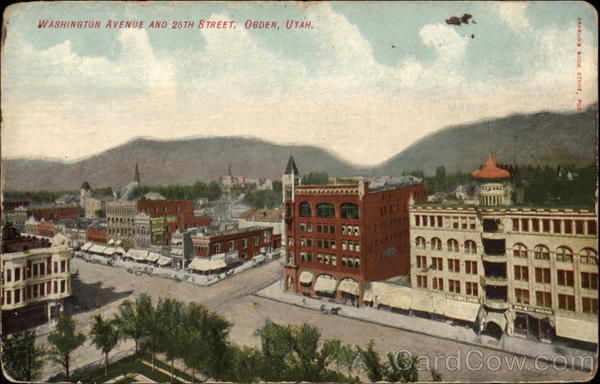
Historic Washington and 25th Street, Ogden, Utah.
It was May, 1903.  Theodore Roosevelt was in the midst of a whirlwind 25 state speaking tour, which included some extensive camping in the newly created Yellowstone National Park.  By virtue of the railroad, Ogden was lucky enough to secure a stop.  They honored the President with a parade down Ogden's majestic 25th street, and also by providing an ample guard.  Sheriff Drake was part of that escort.

Pearl puts this on record.  "President Roosevelt came to make a speech there in Ogden.  My father and several deputies guarded him while he went up to make his speech.  Mother, I, Ira, and my younger brother Emery came along in the buggy."

Wyoming's historical society has a large amount of information about TR's 1903 tour, including links to transcripts of several speeches (they were pretty much the same).  After the speech he got back on the train and was in Evanston by that evening.

"President Theodore Roosevelt is shown in this photo during a visit to Ogden, Utah, on May 29, 1903. From left to right are shown Secretary of the Navy Benjamin Tracy, President Roosevelt and Utah's Sen. Reed Smoot. Roosevelt defended Smoot to the Senate and the Nation when his seating as a Senator was questioned."--Deseret News, 2013.
TR was "the first President to receive full-time Secret Service protection (although this was not at his request)".  It especially made sense because he had become the youngest president ever by virtue of serving as Vice-President under McKinley, who died by an assassin's bullet.  Nine years later, Roosevelt would also be shot in the chest in Milwaukee, but after announcing the commotion to the crowd, unbuttoning his vest and seeing where the bullet had gone through his notes and his eyeglass case before it "pinked" him, he went on speaking for 90 minutes!  He claimed that "It takes more than that to kill a Bull Moose!".  The would-be assassin, a schizophrenic unemployed man, was wrestled and stopped by TR's male stenographer.  (That would have been a bit embarrassing to the guards, I imagine.)  So anyway, the job of guarding the President was very real and I am sure Daniel took it very seriously.  Here's a great article about the attempt written at the 100th anniversary of the shooting, with pictures of artifacts, etc.

Guarding the President was really only one small way of many that Daniel participated in the history of Utah.  Read on.
  • Born at Binghams Fort in Feb. 1853, (before the actual fort was built), one of the forts created for protection from the Indians at Brigham Young's pronouncement to "fort up!" in July 1853.  Erastus Bingham had been a close associate of Daniel's father D. Newell for years and eventually became Newell's step-father.  (For more about Newel's and Erastus's pioneer story, read my post, Ponca Winter Saint.)  The original Erastus Bingham cabin, which would have been very similar to Daniel's and in fact, neighbored it, has been relocated and is on display at Lagoon Park. (Binghams Fort has an awesome historical website.)  The settlers lived in close contact with the Shoshoni Indians, also called the Weber Utes, and after some conflict and resolution, the white men of the fort (like Newell, Daniel was a baby at this time) were taught the Shoshoni dialect at the schoolhouse.  This may have afforded Daniel some skills later in life.  Stay tuned!
    You can see the original fort properties here belonging to Daniel's father, also named Daniel Newel Drake.
The fort walls were made of mud and wattle.  Painting by Farrell R. Collett.
  • In 1858, when Daniel was five, Brigham Young told the inhabitants of Northern Utah to abandon their forts and settlements rather than fight Johnston's army. A few men were left behind to torch the place if necessary, and the faithful departed.  Daniel writes that Newell took his family south to Payson, but they only had to stay about a year before they returned.  The family also lived in Provo from 1863 to 1867.
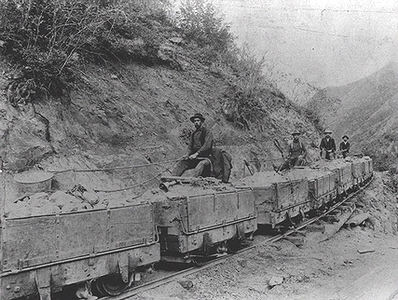
  • Ore Cars, Bingham Canyon 1892.  Descended by gravity, hauled back by horsepower.
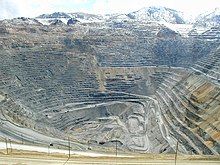
    Bingham Mine 2003 --wikipedia
  • Daniel was a busy teenager and during those years participated in some major, historically significant projects.  He was not your average farm boy.  "I worked on the C. P. railroad down in Grouse Creek in the fall of 1868.  I worked for the Utah Central Railroad in 1869 and was employed by that company until the end of December when the railroad was completed as far as Farmington, Utah.  I went to East Canyon, Tooele Valley in 1871 to work in the mines there and left the same year to go to Bingham [probably the town around the mine, not the fort]"  I don't know if his family connection to the Bingham's had anything to do with this.  The jump from railroads to mining seems a little strange, but the two are actually connected.  Many of the smaller, "local" tracks were built to facilitate the mines.
Utah's rail project was unique because it was a private enterprise, sponsored by the church.  It was really something wonderful.

 A biography on Daniel is included in Utah Since Statehood, and it adds more detail to these years, and to how Daniel was an "upbuilder" of Utah, although the tone seems a bit flowery.   Here is an excerpt.
Daniel N. Drake of this review was reared to manhood upon the homestead farm and early became familiar with the best methods of tilling the soil and caring for the crops, working in the fields when not busy with the duties of the schoolroom. For three years he was employed in the Bingham mines and then returned to the farm. When fifteen years of age he drove a team and helped on the railroad when the line was being built through Ogden. He had a ride on the first passenger train that entered Salt Lake City. He also in the early days took part in several Indian skirmishes, yet the Drake family were friends of the Indians, always ready to share with them and give them shelter, and therefore they won the friendship of the red men. With all of the experiences of frontier life Mr. Drake is familiar and he has lived to witness a remarkable transformation in Utah as the work of development has been carried steadily forward. Not only has he been identified with farming and other interests but has also engaged in contracting for several years. He is now the owner of excellent ranch property, which is highly developed and improved, and he has for the past four years been field superintendent of the canning factory of the Utah Canning Association. He was also the field superintendent of the Van Allen Canning Company in Box Elder county.
Did you catch the part about the "Indian skirmishes"?  I am curious about what that might have been, or how serious (or if they really meant Daniel's father), but the statement that the "Drake family were friends of the Indians" rings true, particularly if father Newell might even have known a little of the Shoshoni language.  Listen to this story about Daniel as told by his granddaughter Irene Drake Parker.
During my grandpa's earlier years, the area was very rural. Indians lived down by the river (Green Hollows), and that was a bit frightening at times.  We loved to hear my grandfather's Indian stories!  The Indian path was west of the old Drake home, and they would walk through our land.  One night the residents were having a meeting at the church and school building on the sand hill (on the south side of the canal), and the Indians entered the building and would not leave.  Someone in charge of the meeting said, "Go get Dan Drake.  He knows how to talk to the Indians."  Someone went and got Grandpa, and after he talked to the Indians, they left. 

Once Daniel became a family man in 1874, he stayed on his farm in Wilson Lane but still participated in several community projects, besides serving as sheriff. I'll let him tell this part because I think it shows the things that he was most proud of.
In 1875 I helped to build the foundation for the first school house in Wilson.  I worked hauling lumber down from the mountains to the lumber yards.  In 1880 I took charge of the Wilson Canal and worked at that for five years.  I was a director of the Wilson Company for two years.  Went into the dairy business and was in that business seven years.  Then I helped build roads for the county and state for 12 years.
He was also:
  •  Founding member of the Republican Club in Wilson Lane
  • Election judge several times in his later years.
  • Field superintendant for the Utah Canning Association and Van Allen Canning Company, and would judge crops.
  • Ditchrider
Along with several other day-to-day, hardworking, community-minded, breadwinner for a large family type activities.  No wonder his funeral was so well attended!


(If you missed part one of Two Silver Pistols and a Blacksnake Whip, the link is listed on the left sidebar.)

Sunday, April 10, 2016

Justice Served, Quaker Style: Aaron Cooper and the Plugged Thug

We know very little about our ancestor Aaron Peter Cooper.  He died in 1836 when his first son, Thomas Benton Cooper, was only a baby, so Thomas didn't really know the man to pass down his stories.  We don't know the names of Aaron's parents or family members.  We don't know how he died, at what age, or when he was born.  We don't know his occupation (although I have a guess).  We have a rumor that either he or his father served in the War of 1812. He may have been a widower, but we aren't sure.  We do know that he was probably born in Mullica Hill, New Jersey, which was a small Quaker town.  We know he died in or near Liverpool, New York (although we don't know where he is buried.)  Part of the problem is the lack of documentation, also that Aaron Cooper is a fairly common name in the area.  (Me>Mom>Grandpa Heagy>C.A.S. Heagy>Martha Justine Cooper>Thomas Benton Cooper>Aaron Peter Cooper).

One important thing we absolutely know is that Aaron was a Quaker.

I love that one of my favorite movies is about a Quaker and stars Gary COOPER.

I've been trying to find out a little more about this man, and was delighted to receive an actual story about him from the town historian in Liverpool, New York.  And it's a funny story!  Especially since Aaron was a Quaker and believed in nonviolence.  That must have been hard in the old days--you had to get creative...

This story was printed in the Liverpool Telegraph, June 1894, as a series of "Recollections and Reminiscences of Several Old Inhabitants of the Town of Salina" for the town centennial. (Salina was the neighboring settlement to Liverpool.)  The story is told by a Mr. L. Godard.

A little background to understand the story:  Salina and Liverpool are on the shore of Onondaga Lake in Central New York.  "Natural brine springs along the lake" were an attraction to the area that suddenly became very accessible with the opening of the Erie Canal in 1825 and the Oswego Canal in 1828.
"During their stay the French noted the plentiful game and fish, and salt water bubbling from the ground in the brine springs.  Salt was one of the very few means to preserve meat and fish and widely used to tan hides.
After the American Revolution, the prospects of salt fortunes drew people from New England and settlements down from the Mohawk and Hudson Rivers.  John Danforth, one of the first settlers in Liverpool, began to boil salt in 1794. ...
Salt blocks, buildings containing rows of salt boiling kettles, filled the Onondaga Lake shoreline from Bloody Brook to Balsam Street.  By 1811, 36 Liverpool salt manufacturers produced 20,000 to 30,000 bushels annually.  Salt was shipped by bateaux to Oswego Falls, then overland to Oswego and the Great Lakes, or by oxcart to other communities along rural "salt roads."
Liverpool became a port village of Yankee settlers, Irish canal workers, and a later wave of German immigrants.  Hotel and tavern keepers, grocers, blacksmiths, coopers, boat-builders, brick makers and builders flourished here with the salt workers."  (from Liverpool Village Museum pamphlet).
The salt industry provides the setting and situation.  Enjoy.

"Old Squire Case['s]....jurisdiction included of course the whole town but he would positively have nothing to do at first hand with anything that happened in the somewhat turbulent region of the salt blocks and along the canal [sounds like an "other side of the tracks" situation].  He drew the line at Brow street.  Employers and employees were all in the same category.  Disputes, difficulties, fights and brawls below the hill were adjudicated generally by two referees whom the squire himself appointed if necessary....

One day...a stranger knocked down a man by the name of John Van Osten and battered him up some.  With one eye done up in a sling and blood in the other he sought the seat of justice.

"Where did this happen?" demanded the court.

"Down in the salt blocks."

"Then take it down there and settle it.  I will have nothing to do with anything that happens down there.  They must settle their own disputes."

He however sent an order to Allen D. Kinnie and Aaron P. Cooper to look into the affair and mete out justice.  Kinnie and Cooper with due deliberation assembled themselves together, and the parties to the trouble were brought before them.  On all the evidence the sentence of the court was that the stranger be fined one gallon of rum; in default of which his head was to be held up to a hole in the reservoir and the plug pulled out. [AWESOME!  I bet they were hoping he couldn't pay the rum.]  He refused to pay the fine and was thereupon placed in position at the reservoir.  Stakes were "druv" so as to hold him in position and the deputies, after all was ready and the briny depths had been stirred to the bottom, knocked out the plug and let the pent up brine do its work.  The culprit, in a voice choked in agitation of the water yelled the best he could for mercy.  Not though until it was thought the ends of justice were properly served was the tompkin [also "tampien"--the wooden stopper like over the muzzle of a gun, ie.,the plug] driven in again and the victim brought back to life.

Solar salt workers in nearby Syracuse, New York, about 1900, image from Wikipedia.

Wednesday, September 23, 2015

"Massas" in Missouri: Aaron Fray and Wesley Green

There are so many unknowns about our ancestors' lives.  We can imagine. We can do our best to learn about the times and places they lived in, or the famous events they participated in, or the people they might have known.  Sometimes we can learn from letters or diaries what other people at the time  were doing and thinking, but usually, the best we can come up with is a couple of names and dates, especially the farther back you go.  Once in awhile, though, you get surprised with something great--a STORY!

That's why I was so excited to find not one, but TWO great stories concerning these 5x great grandfathers of mine from my Ely side, contemporaries and in-laws, Aaron Fray (1776-1854) and Wesley Green (1795-1871).

I don't have many Southerners in my family tree.  A few Virginians who later moved north.  A few Kentuckians who later moved north.  The Frays were in Virginia, and Greens in Maryland, then both families moved to Kentucky, then ended up in Missouri.  That's moving north, right?  Well, in the 1840s, 1850s, and 1860s Missouri was a pretty rough place to live, with a pretty raw and violent mix of peoples and ideologies.  In 1821 it was admitted as a slave state as part of the Missouri Compromise.  (Maine was admitted as a free state to keep things fair, and I had some family up there too at the time, the Philbrooks and Hardys, but we'll talk about them another day.)

The Frays and the Greens lived in the Howard/Randolph county area of Missouri, which borders the Missouri River and lands smack in the middle of the state.  (For those of you interested in the Mormon War in Missouri in the late 1830s, never fear, as far as I can tell these families were not near or involved in the area around Independence.)  The area was settled mostly by Southerners from Kentucky and Virginia, and those Southerners brought their slaves and plantation ways.  By the 1860 census, slaves accounted for 25% of the population in Howard County.  (wikipedia.)

It turns out that both Aaron and Wesley were slaveholders.  Do we have any indication of what kind of masters they were?  (I know you are all crossing your fingers and hoping they were nice.)  Well, I think I have some answers for you.

First Wesley Green.  He was the younger of the two men and lived through the Civil War.  A Methodist Episcopalian (whose church was burned at the beginning of the war.)  He moved to Missouri with some of his brothers (also slaveholders) in the 1820s. He outlived his daughter Miranda who married Aaron's son Henry Fray.  With a generic last name like Green, I wasn't hoping to find much information about the family, but it turns out that Wesley's name shows up in a very interesting list in The History of Chariton and Howard Counties published in (full text on Google Books, pg. 279).

The list is a list of "Colored Recruits from Howard County", SLAVES who enlisted to fight in the Civil War--for the UNION!  The list is 3 pages long!

It includes:
Ollie, owned by Wesley Green
Harrison, owned by Wesley Green
Polk, owned by Wesley Green.

The author of the history includes this explanation:
 "One of the most remarkable facts connected with the history of those times--a fact showing the astonishing credulity of the people--was the belief that the institution of slavery would either remain intact, or that the owners of slaves would be compensated for their loss."
So, although I don't know the fate of any of these slave recruits, (there's a research project for someone...) I do know that by the end of the war, they would no longer have been listed as "owned by Wesley Green"!  I also know that they probably worked in manual labor instead of out and out fighting, so perhaps their lives did not seem that different.

Hopefully Wesley was the type of master who allowed them to fight because it was their wish, not forced them to enlist in his stead, against their wish, as a show of patriotism.

On to Aaron Fray. I don't know how well Wesley and Aaron knew each other (if at all) before their children were married in 1839.  Aaron was a Virginian, and we know something very notable about his time there--he worked at one time as a contractor for one of the most famous Virginians of all--Thomas Jefferson!  This was in 1820, and apparently was some ditch work for the construction of the University of Virginia (founded 1819).  Of course, as a 45 year old slaveholder, it is likely that he used his "subs". Another researcher, Ms. Mertens, on Ancestry.com has written a short biography of Aaron Fray and includes the contract written by Jefferson.  (The original is housed at the University of Virginia.)

Around 1824, Aaron and his wife Lucy moved to Missouri.  Aaron was Lutheran and raised sheep. 

Now for a real treat--and I am so amazed to have come across this.  In 1933 a 97 year old woman named Mrs. Jennie Hill was interviewed for the local paper and was printed in the Wichita Eagle.  She was a former slave, and her master was none other than Aaron Fray!

 (As shared by Kate Machill on Ancestry.com.  The article was also later published in Slave Testimony: Two Centuries of Letters, Speeches, Interviews, and Autobiographies, by John Blassingame, 1977.)


 Jennie Hill, interviewed 1933 in Kansas by Florence Patton. Age: ninety-six, b. 1837, Missouri. Enslaved: Missouri.
Slavery days replete with stories of cruelty and inhuman treatment heaped on the faithful slaves by a crucifying master, stories intensified by Harriet Beecher Stowe’s “Uncle Tom’s Cabin,” are fast becoming mere legends to the younger generation, studied once and then forgotten in the humdrum of daily life.
But to Mrs. Jennie Hill, 633 North Water, mother of the late Robert Hill, for many years head waiter at the Wichita Club and well known to every business man, slavery days are real. For Mrs. Hill was born in slavery nearly 96 years ago.
Today Mrs. Hill lives in a modest home, she read of modern improvements and takes and interest in leading political situations, but her heart and thoughts are wont to turn back to the days of her girlhood, back to the slave days when her owner was “Massa” and his wife was the “Missus.”
Seated in the living room of her home at 633 North Water with her gray hair combed becomingly back from her slender face and dressed in black in mourning for her son, Mrs. Hill went back through her store of memories and brought out bits of her life before Abraham Lincoln freed the slaves, opening to them a new world of they had never dreamed.
Mrs. Hill was 27 years old at the close of the Civil war, was married and had three children, who also were born to slavery.
Looking back to her slavery days Mrs. Hill has much for which to be thankful. Her father and mother were owned by Aaron Fray, a small land owner in Howard county, near Boonville, Missouri. His slaves consisted of this couple who had served the Frays before him [Aaron's parents, John and Rebecca Fray], the 11 children of which Mrs. Hill was the oldest, and an uncle of Mrs. Hill's who was also an old servant in the family. But here let us have Mrs. Hill tell her own story of her experiences in slavery.
"I can remember back to the time when I was a child maybe about five years old. We didn't have the cotton fields in Missouri that are somehow associated with all slaves.
"Massa Fray raised sheep instead of cotton and as soon as I was old enough to work my mother taught me to weave cloth. Then I learned to sew. I helped with the housework, worked on the farm, chopped wood and did everything that other slaves did as soon as my strength permitted.
"But all the work was not without pay. The pay was not in money, of course, but it was in kindness for Massa Fray was the best man that ever owned a nigger. His missus was kind and his children were good to me. They even taught me to read and when I could master a few words I was the proudest little pickaninny in all Missouri.
"Few slaves ever learned to read or write. Schools for slaves of course were not thought of. We were just like so many animals and in many of the plantations the animals were treated far better than the 'niggers.' My mother was also taught to read and maybe write a little. Anyway I know just how old I am for the date of my birth was written down in the Bible. That is something a very few of the remnant of slaves know. They guess at their ages for their ignorant mothers had no way of recording their birth.
"In the 27 years I served my master as a slave I got but two whippings. That in itself speaks for the kindness of the master. Both of these whippings were for little things. In my missus' bedroom was a box where my Sunday best dress and bonnet were kept. Sunday I went to church with her and always after church I had to take them off and lay them out carefully in the box. Guess I must have got in a hurry this one Sunday for I hadn’t been out in the yard long until I heard her call ‘Jen, come in here! Haven’t I always told you to lay your dress and bonnet out straight. Look in there.’
“I looked. The bonnet and the dress were a wrinkled mess. The missus had a switch under her apron and she brought it out and laid it over my legs without ceremony.
“My second and last whipped was sometime later and was given to me by massa’s daughter. She had told me not to go to a party some of the folks were having that night. After awhile massa asked me why I didn’t go and when I told him I had been told to stay at home he said, ‘Lawsy, Jen, who owns you anyway? Go on and go to the party.’
“But the next day the daughter caught me on the woodpile. She said she was going to whip me and told me to put down my ax. I threw the ax down and the handle flipped up and hit her on the let. Then I did get licked.
“Plantation life in Missouri was not like it was farther south. The northern slaves were proud that they were north of the Mason Dixon line and the worst thing that could ever happen to a nigger was to be sent ‘down the river.’
“Much of the old plantation atmosphere that you read so much about in the southern homes was absent from the home of the Frays, but in its stead there was a peace and devotion of us slaves to the white folks which was unknown in most of the southern families. We lived in a log hut less than a block from the big house where the family lived but we were comfortable and always had enough to eat and plenty to wear such as it was. But it was hard work all day, day in and day out and never have anything we could call our own.
“When I was 21 years old I married. My husband worked on a farm a mile or so from the Fray place. In the south the slaves from two or three plantations live in a compound and when a couple marries they just start living together without any ceremony. A ceremony wasn’t much good for a slave wasn’t allowed to take any vows. But I was really married. My husband and I went to another slave on his place who could read and write and knew something of the Bible. He said the same marriage ceremony for us that we had to say over again when we were freed. All the slaves who were living together and had families when they were freed had to be legally united in marriage before they could go out to make their way in the world.
“I was proud of my marriage, performed by the ‘educated nigger’ and I sure got mad when anybody said anything about us, not being married.
“Then came my little babies and just before the war broke out I had three. How well I remember how I would sit in my room with the little ones on my lap and the tears would roll down my cheeks as I would ponder the right or wrong of bringing them into the world. What was I bringing them into the world for? To be slaves and go from morning to night. They couldn’t be educated and maybe they couldn’t even live with their families. They would just be slaves. All that time I wasn’t even living with my husband. He belonged to another man. He had to stay on his farm and I on mine. That wasn’t living—that was slavery.

“Then came the war. All around us we heard of the great Abraham Lincoln but I never saw him. But the missus’ daughters read to us of how great he was and told us how he was poor; how he split rails and wrote with charred wood and walked for miles to borrow books to read. I ate up all that information, for there was nothing in this world I wanted more at that time than an education. But Abraham Lincoln was president of the United States. He was a white boy and I was just a slave.
“There were stories of the bushwhackers killing many of the slaves but we only had a few encounters with the soldiers. On one of these occasions the bushwhackers came into Massa’s house and demanded something to eat. We fixed it for them in double quick time for we were scared to death. Some of the soldiers started ransacking the house but their officer stopped them. We heaved a sigh of relief when they finally left for there had been stories where they carried the young slave girls away with them.
"When Massa died he showed his love for his slaves by making a provision for us in his will.  That provision was that none of our family were ever to be sold to anyone but a Fray. After his death our family was scattered. Some went to one child of the Massa’s and some to another but we were all close and could see each other often. After we were freed my husband left his master and for a year worked for my people. Then we worked for his master for awhile and later came to Kansas where we were determined to give our children the education which we were denied.
“But all slaves did not have the happiness and the peace that was our lot. Cruel masters from the south would come into Missouri and here and there buy up a father, a mother, a couple of young daughters or the sons. They would tear them away from their families and keep them in a little shack until they had bought what they wanted. Then they were driven to the boat landing just like cattle and loaded on the river steamer for the trip ‘down south.’
“Those masters were cruel. They carried rawhide whips and if the women dragged a little in their long march they were lashed with the whips until the blood streamed from their poor cut backs.
“Some people think that the slaves had no feeling—that they bore their children as animals bear their young and that there was no heartbreak when the children were torn from their parents or the mother taken from her brood to toil for a master in another state. But that isn’t so. The slaves loved their families even as the Negroes love their own today and the happiest time of their lives was when they could sit at their cabin doors when the day’s work was done and sing the old slave songs, ‘Swing Low Sweet Chariot,’ ‘Massa’s in the Cold, Cold Ground,’ and ‘Nobody Knows What Trouble I’ve Seen.’ Children learned these songs and sang them only as a Negro child could. That was the slaves’ only happiness, a happiness that for many of them did not last.
“When Lincoln freed the slaves I knew of dozens of children who started out to search through the southland for their parents who had been sold ‘down the river.’ Parents left in the north country searched frantically for their children. But I only know of one case where the family was ever united. Some perhaps were killed in the battles but in the majority of the cases the children of slaves lost their identity when they were taken from the place of their birth into a new country.”
That is the story of Mrs. Hill and her trials and tribulations as a slave. And is it any wonder that today as she nears her ninety-sixth birthday that she sits by the fire and dreams and at night when she lies awake and goes over in her mind happenings of more than a century ago when, as she expresses it, she ought to be asleep.
And when she sleeps it is in a room almost as old as the dreams of the gentle old lady. The bed she sleeps in is of black walnut and is more than a half century old. Her dresser matches it and a chair which was her husband’s has a woven bottom of birch bark. The legs are coming loose and the back is a little wobbly but it is precious to her and will hold a place in her life as long as she lives. And in the corner is a table more than a hundred years old which was a piece of the furnishing of her home when she was a girl in slavery."