It's exciting to "meet" new ancestors, especially ones that have left some clues about what they were like. In trying to discover the parents of my GGGGrandmother Ann Giffin Heagy from Gettysburg, I came across two Giffin wills in her hometown, newly digitized and available on familysearch.org. These wills enabled some large growth in our known family tree.
The first will, dated 1794 was by a Stephen Giffin, Sr., and he mentions mentions a wife and daughter, both named Ann. Hooray! Until I realized that the daughter would have been way too old to be my Ann. Also, the daughter Ann never married or had children. The will also included a Stephen Giffin (Jr.), and his son, Andrew. Andrew is a buzzword here, since our Ann named her son David Andrew, and the David part would have been after her husband David Sr. Are you confused yet?
To clarify, we now have three Anns near Gettysburg, where before we only had one.
1. Matriarch Ann (insert maiden name) Giffin, wife of the will writing Stephen Sr.
2. Ann the "Maiden Aunt" Giffin, daughter of #1.
3. Annie Giffin Heagy, who until now was the end of the line. Now all I had to do was connect her to the others.
For my own brain, I've had to assign these Anns some nicknames because, I
didn't mention before, I keep getting Annie Giffin Heagy mixed up with:
4. Hoopskirt Ann: Ann E. Hartzel Heagy, who married Annie Giffin's son David Andrew.
5. Second Wife Ann: Annie Meritt Heagy, who married David Andrew after #4 passed away.
I'll tell you about Ann #3's nickname in a minute.
Hoopskirt Ann
Second Wife Ann, not blood related
David Andrew Heagy, son of Ann Giffin Heagy, husband to Ann Hartzel and Ann Meritt. And very handsome.
The second will turned out to be by that unmarried, maiden aunt Ann, who lived to a ripe old age. (Maiden Aunt is the polite way to say Old Maid). In the will she leaves several items to one Ann Giffin, daughter of Andrew Giffin of Gettysburg "for her services and attention to me and my sister Elizabeth". She also left young Ann the house, with a gentle condition "I do hereby desire the said the same Ann Giffin continuing to take care of me and my sister Elizabeth during our lives." Bam! This caretaker Ann Giffin is the right age, in the right place at the right time to be our Ann Giffin (as supported by the 1810, 1820, 1830 Census). She would have been the great niece of Auntie Ann, and also the great granddaughter of Stephen Sr. who wrote the will. In my mind I have been irreverently calling my Ann Kiss-Up Ann, because she was taking care of her rich Auntie. I don't know, if I were her, I might have played up the fact that I was Auntie's sweet and dutiful namesake.
The whole situation reminds me of Jo in Little Women reading to her cranky old Aunt Josephine, hoping for some financial support and perhaps an inheritance. In any case, her descendants are very lucky that Kiss Up Ann did her duty, because it prompted Auntie Ann to record the relationship in her will and gave me a boost up over that research brick wall.
So, to guide you up the tree, we are related as follows:
Me>Mom>Grandpa Heagy>Charles Aaron Samuel Heagy>Charles Heagy>David Andrew Heagy>Ann Giffin>Andrew Giffin>Stephen Giffin, Jr.>Stephen Giffin, Sr.
More on this new branch later...George Washington will be making an appearance.
My Dad's cousin Glenna has been helping me acquire pictures of the Haynes family, so I thought I'd share a little story for her about her Dad, my great uncle Glen Haynes.
The Haynes Boys: Glen, Verl, Seth, and Jack. They also have a middle sister Mary, who was probably (wisely) avoiding these hooligans at the time this picture was taken.
This story is from my Grandpa Happy Jack Haynes, Glen's little brother.
"We were only on the [Campbell] Ranch a year or two, then moved to Fort Shaw, Montana. We lived about a mile south of town. On the 4th of July, there was a picnic at the Fort. Glen won a foot race, first prize was 25 cents. The community still didn't trust Mormons, so they decided to run the race again! Glen won again! They were still upset about the outcome, so they split the prize money! Each kid only got 5 cents!"
Astounding.
Jack would have been about 4 when this happened, in the early 30s, so Glen would have been about, say, 13? I could see something like that contributing to a major chip on the shoulder, but as far as I know, Glen didn't carry one. The family moved again about a year later 10 miles west to Simms, Montana. Hopefully community sentiment was better there!
With ordinary small town folk being so ignorant not even a lifetime ago, I guess I shouldn't be so caught off guard when I frequently notice prejudice toward Mormons in mainstream media (even in the well-meaning ones) today. Like Glen, I guess we can just take our nickel and trust that people have great capacity for change.
FamilySearch has a new service that allows you to store photos and stories/bios about the people in your family tree, so I am going through my things again to see what I have to contribute. A phone call to Grandpa Happy Jack was in order since I know very little about the Haynes side of the family, not even having a picture of Jack's Haynes grandparents, even though they lived well into the 1930's (Grandpa says he thinks he has seen one before, hopefully whoever has one will contribute soon.)
I was right. Here is one a distant relative came up with of Henry.
(Me>Dad>Happy Jack Haynes>Harry Raymond (Roy) Haynes>Harry Henry Haynes)
Here is what little I know about this immigrant patriarch of my family.
One of the reasons Henry Haynes and his wife Charlotte (who went by Lottie) are so unfamiliar is because they only met my Grandpa Happy Jack once, at a train station in Ogden when Jack was a tiny boy, sometime between 1927-1930. He said that they were very nice. They were on their way to Lane, Eugene, Oregon, to retire. By the 1930 census they were living with Lottie's sister Maude, who worked in some woolen mills in Lane Happy Jack says one reason they left Minnesota was because of the severe Midwest winters.
We're not even very clear on what his actual name was--maybe someday we'll find the christening record. It may have been as long as Harry Henry Harrison Haynes or as short as Henry. In the 1880, 1920 census he went by Harry, in 1900 by Henry. My guess is that they called him Harry, short for Henry, at home because Happy Jack's dad Harry Raymond (HHH's son), went by "Roy" at home, maybe to differentiate the two? We'll call him Harry, Sr., here.
We know he was born in 1851 in Brentford, Middlesex, England. This area borders London on the west. His parents immigrated ?, possibly first to Canada--Happy Jack says this was because it was easier to immigrate from England to Canada. On the 1920 Federal Census Harry Sr. says that he was naturalized in 1870, but the 1900 Census says they immigrated in 1865. This may mean that they moved from Canada in 1865, not England, because on the 1930 census he says he immigrated in 1852. Someday I'll find the immigration records and we'll know for sure. In any case, we know the family was living in America before the Civil War because Grandpa Happy Jack just shared this charming story with me.
Apparently, young Harry, Sr., declared that he was "gonna be a drummer boy" for the Union Army. He would have been between 10-15, probably close to 15 if they really came from Canada in 1865, toward the end of the war. They were living in Iowa at the time. When his parents told him no, he ran away to find the army and join it.
He didn't make it far, they caught up with him at the next town or river over, and his dreams of glory were dashed forever.
Well, Harry Sr. grew up and married Charlotte Waddington, also an immigrant from Canada, and they raised a family in Iowa, later moving to Minnesota and then Oregon. His son Harry Raymond Haynes, "Roy", mentioned a little about his dad in an interview, probably around 1980, mostly that he had been crippled and got a pension from the railroad in Iowa, then turned to farming. I'm guessing he was a railroad employee; his sons also worked for the railroad.
Cooper was sick today, and Dad is recovering from ankle surgery, so I thought it would be fun for them to entertain each other a little. I've figured out how to use the voice recorder on my iPod, so watch out world. I've transcribed it, but it is probably more fun to listen to: click the link and turn on your speakers..
“Okay, children…This
happened to me back in 1977-78, the winter of 77-78.I took a part-time job at the Western Livestock
Auction …. where lots of cattle come to town!And I was the sorter, out in the backyard sorting cows for size, and
sexing them for steers and heifers, cows and bulls, ‘cause they had to be sold
separate in the pen.
So I was sorting one day, these BIG,
white Charolais cows that weighed 1600 pounds plus.They were wiiiild
and spooky.And I was holding the gate,
and we were letting some go by the gate, and some go by the pen of the gate I
was holding. And so we cut several of them out, and several of them were behind
me, and this one cow was running as fast as she could, and I was standing on
the end of the gate and against the fence; I thought she was gonna go in the
pen with the other cows, but she decided to go right through me into the other cows.And I didn’t move fast enough and she BANG
knocked me over, down on the ground and she run and she stepped on my chest and
put all her weight on my chest, and I staggered up and could hardly stand up.I stood up and I could feel my shoulder
slumped to the side, and I couldn’t hardly walk.And they called an ambulance, but the
ambulance didn’t get there so the people took me in the car to the
hospital.I knew something bad was wrong,
and I got to the hospital and they discovered my collarbone had pulled away
from the breastbone.So they performed a
big surgery, and took the tendon out of my left arm, and cut my chest open and
tied the collarbone back to the breastbone with the tendon out of my left
arm.And there I was in the hospital and
had a long recovery.”
“How long were you in the hospital?”
“I don’t remember how long exactly I was in the hospital,
but quite a while.And I finally got to
come home, and the surgeon did such an excellent joy that it never ever hurt again,
and that’s been thirty some years ago.He did an excellent job.That’s
what happened.I got trampled by a coooow, and she was BIG and white, with
pink eyes that were on fiiire.”
I remarked that I didn’t realize that he’d been working at
the livestock auction, I always thought it had happened at home.He said no, he and Jim Hadley took the job
there to earn some extra money.This was
the winter after he and mom had gotten married, (so luckily, mom didn’t have
any babies to worry about.)
He said that mom stayed in a little apartment there in Great
Falls while he was recovering, he thinks it was one of
the Heagy aunt’s.
He said [laughing] he got worker’s comp for it, something
like 12-20 dollars a week for a while.
I know that this blog is meant to be short stories stories about my ancestors, but today the story that wants to be told is about the discovery process itself. So, readers beware, you are about to be inundated with old Gothic handwriting, conflicting dates, mysterious sisters, funny town names, 4 weddings (with only one groom but three wives--figure THAT one out...), snail mail, cranky librarians and a twice torpedoed steamship. All of it wonderful to a point that brings me chills. (But if you STILL don't want to read this--it is a little lengthy, just scroll down to the links where you can get your own copy of some of these documents, if you would like to have them, frame them, whatever. They are fun to look at, even without my commentary spewing forth.)
I was at the beginning of this story, but I don't remember it very well. When I was about 11, I was introduced to the Pedigree Chart, and immediately became a huge pest. I badgered my Grandpa Heagy plenty, I'm sure. There were too many white spaces on his side of my family tree, and what was he going to do about it? Well, I forgot all about it, but he didn't, and a few years later I vaguely remember being in the Cardston, Alberta temple with Grandpa, Grandma, my mom and brothers, and hearing some of the names that linked up to the white spaces as we worked on making these people part of our forever family.
The names were German.
German genealogy is HARD, sometimes compared to following the white pebbles dropped in the dark forest by Hansel and Gretel. Hard doesn't scare me, but hey, I don't speak German, so for the last twenty years I've been joyfully sifting through pioneers, pilgrims, and patriots. All who obligingly left a trail on American soil, in the President's own English. A few weeks ago I was getting bored finishing up the tail ends of a long project and wondered what my new focus would be. A couple of days later I felt that it was finally time to take the plunge (into the icy Atlantic??) and start working on the Schlomers.
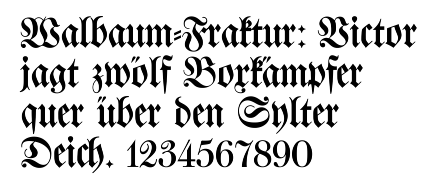
I started out with the easy stuff--some video tutorials on beginning German research with my ironing parked in front of the screen. I learned two main things. One, German Gothic script, also called Blackletter, looks terrifying but can be easily read (decoded) with practice. Would you like to see a sample? This stuff was used in print clear up into the 1940s! Luckily I haven't really had to mess with it much yet.
Don't know what this says, perhaps something about a quick brown fox and a sleeping dog? I know "uber" is over. Have also discovered that I LOVE Google Translate--it does whole paragraphs at a time, German to English, copy, paste, voila. Just not the script stuff.
The second thing I learned is that in German genealogy, pinpointing the right hometown is supposedly the hardest part. This is because there are so many towns with the same names. Right name, wrong town, means wrong, wrong, wrong.
On with the search. First principle of research is to gather up
everything you already have. What do I have about John Schlomer? Some
info about his birthday, death date, and marriage from a family tree
Grandpa put together that is now online at new.familysearch.org.
( If you follow this link, you probably will need to log in.) I
consider Grandpa's information pretty reliable since he knew John
in person. I also know that I am related to John as follows.
Me>Mom>Grandpa Heagy>Cleora (Schlomer) Heagy>John Schlomer.
Lastly, I had already written a
little bit about John's "run in" with the Kaiser on this blog that included some basic bio information, also
with some pictures of John and my mom when she was little.
Lori Heagy and John Schlomer, pre-1962.
Second principle of research for me, is to remember that practical genealogy is the collection of the WRITTEN word. At this point John has one pathetic file. Hurrah for the internet revolution and the Spirit of Elijah that convinces all these volunteers to transcribe digitized documents into recognizable entries! In probably under an hour I had found several records that concern our John Schlomer. (I am still trying to figure out the best way to share documents on this blog, so hopefully these links to Google docs work if you would like a copy. May have to download to see larger...)
1. A marriage license for John Schlomer and Frieda Bornemann
that does not list their parents, dang it. It also does not tell us their exact marriage date because it is only the license. Presumably they would have been married a few days later at a Catholic church. It does let us know that they were living in Bentleyville, Washington
County, Pennsylvania in 1907, John was already working as a brewer, and that John's age doesn't quite match with
the information Grandpa had (why would John have said he was only 23 when he should have been, by all other proofs, about 26? Maybe he was just nervous. When we got our license, my hubby claimed that he was born in Cincinnati, Utah. Haha.) Grandpa and I sent off a request form to the Archives of the Diocese of Pittsburgh (never thought I'd be sending money, well, Grandpa's money, to the Catholic church!) hoping that they have the actual marriage registry, which should have a date and hopefully witnesses who might have been related. When we were looking at this record Grandma also pointed out that they always had thought Fredericka Elizabeth Bornemann had spelled her nickname Freida, but here the signature says Frieda.
2. A marriage record for John Schlomer and Mary Comer. And then...
3. ANOTHER marriage record for John Schlomer and Mary (Comer) Schlomer.
Yes, John married the same woman twice. And divorced her twice. Being twenty years older than the poor girl might have had something to do with it, I don't know. The cool/frustrating thing about these two documents is that we finally have written evidence about John's parents. Evidence that doesn't match! Both records list his father as Anton/Andy Schlomer. The first marriage lists his mother's maiden name as Elizabeth Ricek--very exciting--I did not already know this. The kicker is that the second record lists his mother's maiden name as Elizabeth Vormann (could be Normann). You're killing me here, John! My guess is that one of the times he didn't fully read or understand the question, that it was a maiden name that was required. Perhaps his mother had remarried at some point, or was a widow, or maybe his dad Anton married two different women named Elizabeth. For now, we'll just be happy that we've got options and hope to someday find John's FOURTH marriage record, hiding somewhere in California or Oregon, to a woman named Josephine.
4. A WWII draft record for John Schlomer. Huh, you say? Wasn't he like, sixty by WWII? Was he just getting picked on for being German? No, actually. He had to participate in something called the Old Man's Registration, for all men between the ages of 45-64, for the purpose of identifying useful industrial skills, etc. One very good possible clue from this record is his John's unusual choice of contact--someone who would always know his address. He listed a Mrs. Louise Shaeffer, Cherokee St., St. Louis. At the time John was living in Santa Monica, California. Who is zees mysterious voman? The 1940 Census comes out in April, and I'm hoping to pinpoint who she is. Wouldn't it make sense that this could be a sister? (Or maybe he had a widowed pen pal?)
My next stop was to visit the Riverton FamilySearch Center, where I can access the $$$ subscription required Ancestry.com for free. While I was there I located two exciting records, still in English, lucky for me.
5. John Schlomer's Naturalization and Citizenship record (the next page, for some reason I can't get it to upload here, I tacked it on the end), where he gives a specific hometown for himself: Alme (two syllables) and also a hometown for Frieda: Adorf. Alme is a great piece of info because we already knew the district and region (Brilon, Westfalen, Prussia/Preussen--rhymes with poison). Adorf is also nice but not quite as cool because there are several Adorfs in Germany and we don't know which one we want. John lets us know that he came over on the Vaderland in August of 1903, departing from Antwerp, arriving in New York City. He also had to renounce Kaiser Wilhelm II.
-->
When I read the part about New York City I got all excited that I might find a record at Ellis Island--they have a great website and I've never been able to use it because my other ancestors came over too early. Well, I found the ship, the voyage, and the very long manifesto (1500 and some passengers) but John somehow got missed, either on the manifesto itself or by the transcribers. It would have been easy to do, the record is pretty messy and torn in places. I even tried searching by anyone in their twenties, and he still didn't show up. This would have been a nice record because the passengers had to list who they were coming to visit. If anyone feels like combing through, name by name, be my guest. It was pretty cool to read about the Vaderland's crazy history. (Grandpa also liked that part...surprise.) It was a bit unlucky, getting torpedoed by U-boats in 1915 AND 1917, when it finally sank.
6. A ship
manifesto entry for Frieda Bornemann, traveling on the Reine,
departing from Bremen, arriving in Baltimore in 1906. The crazy thing
about this record is that she is coming to America for the 2nd time,
having been to Chicago the year before! She paid her own way and left
the ship with at least $50 declared. (They didn't make them declare
more than that.) She also had to answer all kinds of crazy questions
that must have been pretty nonsensical for any non-English speaking
passenger, such as whether or not you practice polygamy. The best part
of this record (as usual, also the most infuriating) is that Frieda says
she is going to visit her sister in Charleroi, Pennsylvania. We did
not know that John or Frieda HAD any siblings at all. The infuriating
part is that the handwriting is not quite clear enough to define for
certain. Here, have a go at it. I welcome input. The first word is Sister, the initial is R--I think, because the word underneath it is Fourth, but it could be a B. The married name (we know she's married, otherwise her last name would be easy--Bornemann) is tricky because it's getting some interference from below, and this clerk's capital letters are extra loopy. Check out that "C" on "Charleroi", Pa.! The librarian and I worked at it for a minute and our best guess was Loehner. Could be totally wrong. When I got home I hit on a verrrrry interesting possibility. One of John's cronies, a fellow brewer who witnesses John's naturalization petition, is a Herman Lackner. Unfortunately, Herman's wife's name was most definitely Mary, so that's not quite it. There are more than one Lackner in the area, though, and they are also German. We'll have to see what comes back from the Catholic Archives and hope that Frieda's family was close.
I called Grandpa to inform him that he now had a Great Aunt R. and found out that he was already down here in Utah. He and Grandma came for a fun visit. They also were extremely kind to come a different day to the world-renowned Family History Library on temple square. Grandma and Leslie patiently scrolled through departures from Bremen looking for Frieda while Grandpa and I looked for Schlomers in a Catholic church book microfilm from Alme. I was sure we'd find John's baptism record or the marriage record of his parents (and determine once and for all his mother's last name) but we didn't have any luck, other than to find that Schlomer is a very uncommon name. My guess is that there was more than one parish in Alme, or his parents baptized him somewhere else. When I tried to clarify the one entry for a Schloemer that we did find, the librarian didn't understand my question and seemed a little put out that I had already found the film number. In any case, I was glad for the Grandpa and Grandma's help because I would have been looking through those records all by myself, anyhow.
As we were winding up at the library, a senior missionary approached us with a big smile, noticing our three generations hard at work. He told us that we were so lucky to be doing this together. I agreed.
So now we are at another impasse, hopefully not for long, but I think John and Frieda and their families are wanting us to keep them in mind.
During a holiday trip to Montana, my Dad was telling me about the history of the Church of Jesus Christ of Latter-Day Saints in the area, and how the hand of the Lord has been involved in the growth of the church and the people there. One of the stories he shared with me was about his grandfather, Harry Raymond Haynes.
Harry joined the church as a young father in April, 1922. He had married Pearl Drake in 1917, a member of the Daniel Newel Drake family--all members of the church from pioneer stock. The Lord knew that Harry had some big decisions to make when he married Pearl, and He blessed him with the time to make them. When Harry was drafted during the latter part of World War I, his brother-in-law and employer, George Britting (husband of Harry's big sister Celia), went to the draft board and requested that Harry be allowed to remain at home because he was the only "stone dresser" at Albertson's flour mill and they couldn't do without him. The draft board told George he could have Harry until he trained a replacement, but that after that he needed to go. (According to Grandpa Happy Jack Haynes, Harry's son, a stone dresser was the person who smoothed the grooves of the millstone and oiled them.) George found a possible replacement, but was not impressed with him at all, and told Harry to take his sweet time with the training. In a few months, the war was over, and Harry never had to step into the muddy trenches of France.
In the story my Dad told me, though, the mud was the blessing.
Harry and Pearl were brought to the Great Falls area (Manchester) around 1930 by the UNI Sugar Company to sharecrop sugarbeets. A few years after that they moved to the Simms, where Harry rented property from his best friend, Clint Jenson. Although the price was acceptable, the house they were living in was out in the field and did not even have a bathroom or an outhouse. (See the post "Sugar Mama: Pearl Drake Haynes") While they were living there, the decision was made to build a chapel in Simms. At the time, members of the church were asked to come up with the funds to build chapels and temples in their own areas. A "building assessment" was made, and Harry was asked to contribute $10 to the cause.
Well, (as President Hinckley was fond of saying) it was the bottom of the Depression. Because the Simms Bank had gone under, Harry had lost his life savings of $300, did not have a red cent to his name, and worried about how in the world he was going to come up with that money. (It is a testimony of his faithfulness to his newfound religion that he didn't just tell the church leaders to take a long walk off a short cliff.)
I'm sure Harry and Pearl prayed for the Lord to provide.
It just so happened to be irrigating season. The dirt road had been flooded and became, for a short time, impassable with mud. One night at about 2 o'clock, a man who had been doing "a little too much celebrating" walked through the field and knocked on Harry's door; his vehicle was stuck and he needed help. He had come to Harry's door because his was the only light on. Harry promptly hitched up the team and pulled the man out.
The man asked, "What do I owe ya for this?"
Harry said, "Nothin. I'm glad to do it."
The man paid him ten dollars for the assistance, anyway. Ten dollars (besides being the exact amount that Harry needed) was a big chunk of change; equivalent to about $160 in 2011.
Harry willingly handed the money in to the Branch President for the building fund (I'm guessing that this choice was made a little easier by recognizing the Lord's hand in his windfall) and the church was built.
This is a picture of "Grandpa and Grandma Drake's 50th Wedding Celebration, 1924" given to my brother by Eldon Drake, including a page of labels. I wanted to put the picture of the whole family in here (even though they are the inlaws of this story) because it painfully highlights Grandpa Harry's economic situation, even years before the family moved to Simms. Harry is the only man not wearing a tie (Levi overalls instead) and his two boys on the front row are wearing similar getups. Tough times.
PS. Grandma Pearl always called Harry, Roy, so the picture labels him as Uncle Roy. He also had a happier personality than this picture suggests.
PPS. How in the world did they get all those little kids and babies to ALL look at the camera??? I only have four, and I can't do it!
1st Row: Ralph Drake, Jack Hartley, Aline Hadley, Dan Hadley, Glen Haynes, Verl Haynes, Virginia Drake, Paul Drake, Helen Drake, Blaine Drake, Irene Drake
2nd Row: Alice Drake, Marge Drake Larson, "Roy" (Harry) Haynes, Mildred Drake, Effie Hartley, Mary Jane (Cheney) Drake, Daniel Newell Drake with Eldon Drake, Elmer Hadley, Earl Drake, Edna Drake
3rd Row: Jack Drake, Ira Drake, Brig Hartley, Mae Drake with Betty Drake, George Hadley, Rose Hadley with Helen Hadley, Lewis Drake, Mary Haynes and Pearl Drake Haynes, Newell
Drake, Hazel Drake, Fern and Verna Drake Hartley
Rolland Arthur Ely, ca. 1945
(Fairfield School Board picture)
In a fleeting effort to improve my mind, I checked out a book of poetry from the library. To my surprise, I enjoyed it more than I thought, especially when I came across a familiar poem, one that I think I have only heard once in my life. I had to ask mom where I might have heard that one memorable delivery, and she said she thinks it was over the pulpit (or at least the microphone) during a fast and testimony meeting when I was a teenager.
The poem was memorable because my Great-Grandpa Rolland Arthur Ely was the one reciting it. He did it completely from memory, having learned it as a schoolboy. It was also memorable because the poem is a fitting theme to honor his life of quiet service and friendship.
So, go ahead and read this out loud, maybe picturing Grandpa Ely's quiet, melodic speaking voice, and think of what things you might be doing better this Christmas season to love your fellow men.
(The picture is from Uncle Jim Ely's picasa album).
Abou Ben Adhem by James Leigh Hunt (1784-1859)
Abou Ben Adhem (may his tribe increase!)
 Awoke one night from a deep dream of peace,
 And saw, within the moonlight in his room,
 Making it rich, and like a lily in bloom,
 An Angel writing in a book of gold:

 Exceeding peace had made Ben Adhem bold,
 And to the Presence in the room he said,
 "What writest thou?" The Vision raised its head,
 And with a look made of all sweet accord
 Answered, "The names of those who love the Lord."

 "And is mine one?" said Abou. "Nay, not so,"
 Replied the Angel. Abou spoke more low,
 But cheerily still; and said, "I pray thee, then,
 Write me as one who loves his fellow men."

 The Angel wrote, and vanished. The next night
 It came again with a great wakening light,
 And showed the names whom love of God had blessed,
 And, lo! Ben Adhem's name led all the rest!