Friday, July 25, 2014

A Ponca Winter Saint: D. Newell Drake

D. Newell Drake[1]  (1819-1879) was an early member of the Church of Jesus Christ of Latter-Day Saints. When he was a young father, he found himself in an overturned world. Joseph Smith the Prophet had been murdered.  Thousands of people were in flux, forced from their beautiful city Nauvoo, Illinois.  Most, including Newell, chose to follow the prophet Brigham Young, pioneering across the plains to what would become Utah.

Newell’s pioneer experience really illustrates the learning curve of an entire people trying to figure out just what it means to follow a Prophet of God.  His story is unusual and deserves a full telling, particularly of the winter he spent with a small group of Saints among the Ponca Indians.
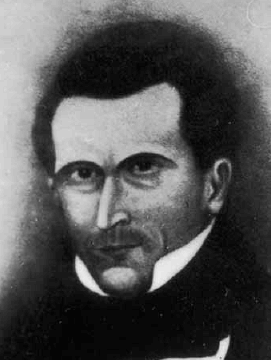
D. Newell Drake, II.  Utah Pioneer.

Before the Journey

At some point in Newell’s childhood, probably around 1826,[2] the Drake family had decided to move “west” from eastern New York to Ohio, and then to Illinois around 1835,[3] the rest of their large clan (Newell’s mother was one of 13 siblings) remaining in Vermont or New York, (save one Aunt Sally who also came to Ohio).[4]  Perhaps this already-established separation from the family greased the wheels a bit when, years later, they made another huge life change—joining the church and then moving much further west.  One notable exception was Newell’s elder sister Diantha Drake Barnes.  She had married in Trumbull County, Ohio in 1835 and remained there with her husband, eventually moving to Michigan.[5]  The Barnes’ did not join the church.

Newell joined the Church of Jesus Christ of Latter-Day Saints at age 22, in the spring of 1841.  Genealogy records online indicate that his little brother Orson might have joined as early as 1839, but other accounts indicate that the entire family (Daniel Sr., Patience, Newell, Sarah, Orson and Horace) joined together in either March or May of ‘41.[6]  Newell was baptized in La Harpe, Illinois, just weeks within the establishment of a branch of the church there.[7]  As far as I can tell, both of Newell’s parents were the only members from each of their families, which may not have even been religious in the first place—Daniel Sr. and Patience had been married by a Justice of the Peace instead of a minister of any particular church.[8]

From Church History in the Fulness of Times Manual
The Drakes had moved to La Harpe, Illinois, in Hancock County (about 25 miles east of Nauvoo) sometime around 1835[9], the same year as sister Diantha’s Ohio marriage.   La Harpe had no special connection to the church until about four years later, 1839, when dislocated Saints from Missouri, particularly Erastus Bingham Sr., moved there.[10]  In other words, the Drakes were there a few years before the Saints arrived.  

 La Harpe is described by church historian Donald Q. Cannon as one of several “’missionary towns’ in Illinois—places where the Saints lived among nonmembers, whom they hoped to convert to the gospel”.[11]  This plan apparently worked for the Drakes, although the Saints never became a majority in the town. [12]  Erastus Bingham was the earliest Latter-Day Saint settler there and did much missionary work, also a man named Zenos Gurley.  Either of these two men could have been the missionary that taught and baptized the family, but regardless of who performed the ordinances, Bingham particularly was to play a significant role throughout Newell’s life, always seeming to be present at the turning points.  He served as his ecclesiastical leader[13] and eventually became Newell’s stepfather[14] after Daniel Sr. died in Utah, and was Newell's longtime neighbor in Utah.  (Bingham's original pioneer cabin-- that would have neighbored Newell's-- is on display at Lagoon's Pioneer Village in Farmington, Utah.)  

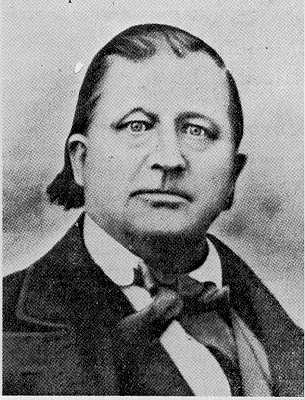
Erastus Bingham
Newell was married in La Harpe to Cynthia Parker Johnson on 4 Jan 1844.[15]  He was 24, she was 19.  They took up residence with or near the family and by the end of the year had a baby girl, Lucy.[16]

For the young Drake family, life was just beginning and this could have been a time of peace and prosperity.  Instead, it became a time of tumult, growth, and hard choices.  Unfortunately, Newell did not leave a journal or memoir, so we don’t know his day to day thoughts, motives, or activities.  The best we can do is piece together possibilities of what might have happened from the facts that we do know.  Luckily, several of his contemporaries did keep descriptive records of their common experience.

On 27 June 1844, the Prophet Joseph was martyred.  In August, Brigham Young and the Quorum of the Twelve Apostles were sustained in a General Conference as leaders of the church.  We don’t know if Newell attended this conference, after all, La Harpe was 25 miles away from Nauvoo.  What’s important to note is that he continued to support the church leaders by his actions, confirming that he was in agreement with the decision.

The year after the prophet was killed, the Saints were busy trying to complete the Nauvoo Temple.  They also continued to face persecution.  Once again, I don’t know how likely it is that Newell helped in the temple construction because he was not that close to Nauvoo—unless he had moved there.  Neither does it seem that he nor his parents or siblings received their endowments there, once it was finished.[17]  It is possible, however, that the Drakes did in fact move to Nauvoo for this interim.  One history of Erastus Bingham claims that the Saints living around Carthage (this would include La Harpe) were exceedingly nervous of mob violence after Joseph was martyred, and so, the Binghams moved to the opposite side of Nauvoo in the spring of 1845.[18]  Their neighbors the Drakes might have done the same, although we don’t know exactly where they might have stayed for that last year the Saints were in Illinois. 

As far as evidence of persecution that might have threatened the Drake family directly, there is one story of note. A mob in La Harpe threatened a prominent church member, a miller, Lewis Rice Chaffin, when they found him secretly grinding grain for other members of the church in the dark of night. 

“If you grind a grain of flour for the Mormons, we will blow your brains out!” Chaffin replied: “Let me grind my own toll.” The mob retorted with taunts and foul language, but they left him to grind all the grain he had brought.”[19]

Iowa Crossing and the Ponca Camp

By February of 1846, the forced exodus was underway, the slow and arduous first-leg of the journey west, across Iowa, was ahead.  We don’t know what company Newell was aligned with for certain or what the circumstances of his Iowa crossing were, but it is possible to have a pretty good theory based on where he ended up that winter, and with whom. 

Newell probably traveled in company with his former church leader, Erastus Bingham, who at one point (timelines conflict a bit here, probably because things were being constantly reorganized) was made Captain of One Hundred in the Daniel Spencer/Ira Eldredge Company.[20]  The pioneers were governed into smaller and smaller segments modeled after the organization of the ancient Israelites, Captain of Ten being the smallest. It is likely that Newell was in Bingham’s division because
            1)of his previous and future associations with him
            2)they both were among a small group who wintered at Ponca Camp
            3)also because Newell’s parents and brothers later continued to Salt Lake in this same Daniel Spencer Company.[21] 

At this point it might be helpful to show a timeline of the forces and events that were affecting Newell’s family, drawn from well-established church history and also accounts of his siblings and other travelers who were closely aligned with Newell, such as Erastus Bingham, Joseph Holbrook, Anson Call, Newel Knight, and David Miller.


February 1846
Wagons start to cross the frozen Mississippi from Nauvoo.

Spring (March?)1846

Crossing the Mississippi

The Drake family, which includes Newell’s parents and siblings, crosses the Mississippi.[22]  Horace Drake claims that the family crossed at Fort Madison,[23] which is actually about 9 miles upriver from Nauvoo.  They progress slowly across muddy Iowa with the main body of the Saints.

12 June 1846

Miller vanguard


The Camp of Israel (Brigham Young’s name for the main body of travelers, which would have included Newell) is camped at Mt. Pisgah, about 2/3 of the way across Iowa.  Brigham Young is dissatisfied with the slow progress and creates a small well-equipped company of 32 wagons, under Bishop George Miller, to push ahead across the Missouri River (the Iowa border) with the intent to improve roads and bridges, locate campsites, collect firewood,[24] and continue to the Rockies. 
 We first meet George Miller, who becomes a bit of a villain in our story, in Section 124 of the Doctrine and Covenants, given in 1841.  At that time he is described as “without guile” and that he may be “trusted because of the integrity of his heart”.  He was called to be a bishop and accomplished many noteworthy things that built the kingdom.[81]  Like some others, though, in the end he struggled with fully accepting the rightful leadership of Brigham Young, disagreeing or disapproving of his decisions.  He was disfellowshipped not long after Newell safely arrived in Utah.  George Miller did not complete the journey, landing in various apostate groups in Texas, Wisconsin, Michigan, and finally back to Illinois.[82]
George Miller

Newell witnessed Bishop Miller’s downfall up close and personal.  Throughout the crossing of Iowa in 1846 Miller repeatedly disobeyed Brigham Young, pushing ahead with his small company and separating from the main body of pioneers.  I hope that Newell was not part of Miller’s company, but I don’t know when or with whom he crossed Iowa, although if I had to guess I’d put him with Erastus Bingham once again.  What I do know is that Newell Drake’s, Erastus Bingham’s, and Bishop Miller’s stories intersect at a place called the Ponca Camp.

 About the same time, a Presbyterian mission at a Pawnee village 114 miles further across the river in Nebraska is attacked by Sioux raiders.  With Brigham Young’s permission, the Presbyterians hire Bishop Miller’s advance company to go to the mission and retrieve belongings, etc.[25]  This chain of events directly affects Newell and his family. 

Early July 1846

Mormon Battalion recruited

Horace Drake
The Camp of Israel (includes the Drakes) has completed the Iowa crossing and camps at Council Bluffs on the Missouri, a site where Lewis and Clark had held “council” with the Indians about their journey upriver about forty years earlier. The Mormon Battalion is recruited and mustered here.  We know the Drakes are present because Newell’s little brother Horace Drake tries to enlist but is denied due to a bad arm.  Daniel Sr. does not allow little brother Orson to join without Horace.[26]  I don’t know why Newell does not enlist. (I suppose, then, that maybe there is a small case here for his association with the Miller group or some other distant task force—additionally, one member of the Miller group later reported that Miller did not even inform them about the call for troops, making it too late to enlist when they did find out since they were deep into Nebraska at the time.[27])

16 July 1846

Heber and Brigham companies

Brigham Young announces that another, larger group should be sent ahead into Nebraska to join the Miller company.  This larger group consists of a company of 68 wagons recruited by him (Brigham Young) and a group of 73 recruited by Heber Kimball.[28]  The Drakes[29] and Erastus Bingham were part of this 68, called Brigham’s Co.[30] (although Brigham Young was not traveling with them.) The rest of the saints would make temporary settlements, stopping the time being in the Council Bluffs/Winter Quarters area on the Missouri. 

1 August 1846

Loup Fork

After having journeyed into Nebraska along the Platte, Brigham’s Co. and Heber’s Co. and join Miller’s Co. at Loup Fork, near the Pawnee mission, making about 200 wagons and 600 people[31].  Also having joined the group was the “rogue” company of James Emmett, lately arrived from their Fort Vermillion, South Dakota, where several saints had basically been duped into moving west before the directive was given, by Emmett, who was kind of a hot-shot frontiersman.  (Church leaders had traveled to South Dakota and requested that the members there accept rebaptism as a token of their loyalty to the Twelve.)[32] Miller and Emmett together were a disaster waiting to happen, neither in open rebellion but both on the verge and full of their own grand ideas.

7-9 August 1846

High Council formed

Invited to Ponca lands

A message arrives bringing new orders from Brigham Young to form a High Council of Twelve with George Miller as President (thankfully, the council also included Erastus Bingham, Newel Knight, Anson Call, Joseph Holbrook and others, and notably, no one from James Emmett's South Dakota company).  The Council was told to make arrangements to winter in the area and to use their own judgment how to prepare for winter.[33]
 
This decision was not without drama.  George Miller was not happy about Brigham Young’s directive to stop forward progress and wanted to disregard the order.[34]  (Although the Holbrook account says there was “a good spirit with the brethren as to their duty”.[35]) The company tarried for three days discussing and deciding what to do.[36]   Ultimately it was up to the High Council and their unanimous vote although the blame of the decision somewhat erroneously falls on Miller. 

White Eagle and Chief Standing Bear were Ponca youths when the Mormons wintered near their tribe.  (Photo from firstpeople.us)
In the midst of the considerations, a chance visit from some traveling Ponca (or Puncaw) Indians offered a surprising new opportunity. The Indians warned them that they were not in a safe place because of warring Pawnee and Sioux. The Poncas were kind and the Chief, aware that the Saints were refugees having been driven out of the States,[38] invited them to camp for the winter “three sleeps” away near their home at Running Water or Swift Water Fork (the Niobrara River, tributary to the Missouri) where there was plenty of water, wood, and feed for the stock that they were welcome to.[39]

At this point Erastus Bingham stood up on a wagon wheel and declared to the crowd his intention to follow the Prophet Brigham Young’s orders to cease westward progress and invited the company to take the Ponca’s up on their offer of a safe camp until spring.[40] The High Council agreed in good conscience without any chance to confer with leaders still on the Missouri, leaving behind 14 families who refused to follow Miller[41] (about ten percent) to keep up relations with the Pawnee.  (Brigham Young recalled this last group to Winter Quarters in October, concerned about their “precarious” position and circumstances.)
“[Brigham]Young concluded that Miller 'was deceived in reference to the locality of Puncha and that he was running wild through the counsel of James Emmett.'...Young’s objections to Miller’s course were both political and religious.  They [the apostles] were well aware of Emmett’s sordid track record among the Indians and the unkind attitude both the Sioux and Indian agents harbored against him.  They also feared that an isolated Saint   encampment on the Southern borders of Sioux territory was an open invitation to serious trouble, a move that might endanger the entire Mormon settlements at the Missouri.  Emmett was a maverick, a wild-eyed dreamer in young’s mind.  On the other hand, Miller greatly esteemed Emmett.  “The excellencies of this man Emmit as a skilful hunter and pioneer cannot be too highly spoken of,” said Miller.  “He was perhaps never excelled, even by the renowned Daniel Boone.” But Young was convinced Miller and Emmett had been too easily persuaded to winter with the Ponca and might well become unwilling instigators of Sioux attacks.”[42])

12-23 August 1846

Arrival at the Niobrara

The company travels 150 miles north through Nebraska with the Ponca Chief to the mouth of the Niobrara River (across from South Dakota, much more than "three sleeps", proving right Brigham Young's prediction of incorrect estimation of locality).[43]  They had to make much of the road themselves but were able to hunt buffalo and have plenty of meat.[44]  It took them "ten sleeps."
Winter Quarters would have been near Omaha.  Also visible is the Loup Fork where the Ponca Saints headed north, and the mouth of the Niobrara where they camped.  The Saints later followed the North Platte route to Utah.  (From Wikipedia.)

When they arrived the Poncas flocked around them, “eager to see our Cattle, sheep, Hens, Pigs, and in fact almost everything we had was entirely new to them.”[45]   The Indians are good hosts, keeping order, offering the Saints a chance to look around and choose their campsite.  The Saints offer to put in corn in the spring and help with any blacksmithing needs.[46]

“The Winter Quarters period in church history, 1847-1852 has, until recently, been neglected in Mormon historiography.  It has now come to be considered one of the most important periods in Latter-Day Saint history, "Mormonism in the raw," as one student put it. During these years Brigham Young became president of the Church (in 1847) and inaugurated many policies and practices that were later applied in the Great Basin.  Particularly important were the lessons learned from being in close proximity to Indians--how to understand Indian life and customs, how to trade with Indians, and how to prevent and punish Indian thievery, for example.  Equally important were the lessons learned about surviving on the frontier, and how to lead and hold together a people under adverse conditions…” (Mormon Pioneer National Historic Trail, “Historic Resource Study”, Stanley B. Kimball, Ph.D., May 1991, from mormontrails.org.)

The company of Saints at the Ponca camp was about to gain a wide variety of experience crucial to their success in settling Utah. 

August-early September 1946

Haying

The company explores options of various campsites and harvests the tall grass for hay for the winter.  There is some discord in camp; some of the men refuse to hay, others wish to travel down the Missouri (presumably back to Council Bluffs) alone.[47]

8 September 1946

Building the Fort

Winter Quarters established

Having decided on a site on the Niobrara about 2-3 miles from the Missouri, a fort is laid out, consisting of two rows of cabins facing inward, the rows being 106 feet apart, with gates on each end, divided into 110 lots, all taken.[48]  About 150 families settle here. They are the first whites to settle in upper Nebraska.[50]

Around this time Winter Quarters is established for the main body of Saints at Florence, Nebraska and includes many nearby temporary settlements.  (The Ponca camp is not at all close to this  web of settlements at Winter Quarters and has, therefore, frequently been overlooked by students of church history.)  The Saints at Winter Quarters also deal regularly with Indians—mostly the friendly Omaha and the Oto (not as friendly).[51]

Brigham Young could have ordered the company home at this time, but did not, perhaps because the resources available at Winter Quarters were already spread thin.  Instead, he sent strict instructions to George Miller and the High Council to fulfill all promises made to the Poncas, maintain strict neutrality between tribes, and ‘cultivate the spirit of perfect peace’. He also included the open invitation “If you want to locate your families here [Winter Quarters] you have only to build a boat and drop them down to this place where you can become partakers of such like blessings as we enjoy.”[52] 

13 September 1946

Daughter born

Consecration rejected

In the midst of construction, Newell’s wife Cynthia bears her second daughter, Cynthia Remina Drake.[xxxiv][53]  The Ponca chief (probably the one who had issued the company the invitation) died the day before and was buried somewhere on the bluffs.  Also, some Sioux come into the camp and smoke the peace pipe[54] which was probably a relief to the Saints (although the gesture didn’t amount to much).  Joseph Holbrook recounts at least two skirmishes between the Ponca and Sioux during their stay, aggravated by the threat of the Saint-Ponca alliance.[55]

Also during September James Emmett and George Miller promoted a forced common property--a law of consecration, (a principle taught by Joseph Smith.)  This push might have stemmed partly from the relative destitution of Emmett's South Dakota company and occasional slights of selfishness toward Emmett's company.  The idea of common property was unpopular among the company and highly discouraged by the High Council, who considered it out of their authority to establish such drastic measures.  Miller argued that as a Bishop, it was within his right to attend to the properties of the church, trumping the high council, and that it was God's will that he do so (insinuating that he was God's mouthpiece).  Brigham Young caught wind of the disagreement and sent a letter discouraging the idea, specifically "until we are more perfect, all such attempts will end in poverty and confusion."  Resources were not pooled, but discord remained. [84]

End of September

Cannon arrives

Some members of the company return from a river trip (about 20 days round trip) to Winter Quarters, bringing with them a cannon and instructions from “the twelve”.[56]  (During this time the Saints acknowledged the Twelve Apostles as the leaders of the church--Brigham Young and the First Presidency were not sustained until the following December.  This may be one of the reasons Bishop George Miller felt he had just as much say as Brigham Young—Miller struggled to accept his leadership, feeling that the members of the Council of Fifty should have just as much authority.)

October 1846

Venturing out

Some men of the company are sent downriver (it is not known if Newell or his brothers or father were a part of this expedition) to Missouri to buy grain, stopping at Winter Quarters where Bishop Miller was tried for some unnamed misconduct, possibly for ignoring a letter from Brigham Young that told him to bring everyone back to Winter Quarters.[57]  (If this particular rebellion is true, it had great ramifications for the Drakes, who suffered a death in the Ponca Camp that winter—of course, though, many also died at Winter Quarters.) While Miller was there, Young overheard his grumblings about Young and the Twelve and promptly blasted him.
"He [Young] handled the case very ruff.  He said that Miller and Emmett had a delusive spirit and that anyone that would follow them would go to hell, etc....that they would sacrifice this people to aggrandize themselves or to get power."  --Willard Richards [89]    
Another handful of men, including the chronicler Joseph Holbrook and James Emmett, are sent on a scouting mission West, probably along the Niobrara, intended to go as far as Fort Laramie, to look for a likely route to the Salt Lake Valley to use in the Spring.[58] (Holbrook does not mention any of the Drake clan as part of this small expedition.) George Miller and James Emmett seemed to have their hearts set on this more Northerly route for the exodus and desired the entire body of Saints to travel this way.[59]   Brigham Young favored the Platte route, which was in fact, chosen.  In any case, the scouting mission proves unsuccessful and difficult and the men come close to starvation; Holbrook reports learning to eat skunk.

December 1846
Fire

The company was living on short rations,[60] and their livestock were regularly stolen by Indians or preyed upon by wolves.  The Indians would also start prairie fires to hunt herds of buffalo, leaving no grass for the Saints’ livestock.[61]  Christmas Day brought a particularly frightening disaster, later colorfully described by camp member Wilmer Bronson, in the writing style of his day.
“At length the fire had got to within three miles of the fort.  The scene now became grand beyond description.  The massive flames soared aloft and lit up the horizon to such an extent as to make the smallest object discernible at any time of the night.  A death-like silence prevailed every bosom as we impatiently awaited the consequences of the coming catastrophe…
“On the evening of the 25th of December, 1846, a scene indescribably horrid was enacted wherein the element of fire became the aggressor, and our haystacks, cattle yards, woodpiles, and so forth, the sufferers.  The young and some of the old people of the fort were quietly and peaceably enjoying themselves in the dance when all of a sudden their apprehensions were aroused by a report from some of the company who had been out viewing the progress of the flames, that the fire had made its appearance on top of the hill about a mile distance.  At the same time the wind commenced blowing a fearful consternation throughout the entire fort.
“The dancing room was immediately vacated.  Men, women, and children rushed from their houses, running with all possible speed to the outside of the fort, where they could have a full view of the danger which threatened…
“A line was immediately formed including men, women and children extending from the river to the outside of the fort, with buckets, kettles, and so forth, by which great quantities of water were thrown on to the haystacks and sides of the houses most exposed to the flames.  Others were using every exertion within their powers to secure their household effects by carrying them down to the river, where it was hoped they would be secure. 
“During this time, the wind had increased to almost a hurricane, driving the fire with almost race-horse speed, which came rolling and thundering down the long slope of hills lying on the west of the fort.  Like a powerful avalanche consuming almost everything that came in its way, the dreaded crisis at length arrived.
“When the flames had reached to within two or three hundred yards of the fort, the cattle and horses became panic-stricken and broke out of the yards and ran in all directions, over wagons, fences, and other things which might be in their way.  Pieces of manure which had become hard through the effects of the sun caught fire and came rolling with lightning speed through the corrals and stockyards, setting on fire haystacks, woodpiles, fences and so forth.
“The scene now became grand, beyond description.  The smoke had become so intensely suffocating as to compel us at times to repair to the river, which was but a few rods from the east side of the fort, and throw water in our faces to prevent choking.  Mothers could be heard calling for their children and children for their mothers; while others were on their knees praying to the Almighty to preserve their lives and that of their property.
“The efforts of the entire camp was now directed to throwing water on the houses nearest to the burning haystacks in order if possible to prevent them from catching fire.  The entire night was occupied in this way.  When daylight made its appearance, the fire was so far under control as to indulge in the hope that the houses were entirely secure from the effects of this destructive element….Be this as it may, one thing was very evident, we were minus a great many tons of hay and other kinds of property.” [85]
Holbrook sums up the fire as follows:
“It spread over the prairie as fast as a horse could run.  The brethren undertook to backfire around the camp when the whole prairie in light presented one sheet of blaze.  It soon reached our camp.  The stacks of hay on the back of our house were towards the fire. 
“There were some 200 men and women engaged in bringing water from the river.  [Remember, this is at night in December, in what was probably bitter cold.] A number of stacks of hay took fire and five were burnt.  One good wagon for Brother Bartholomew and a number more badly injured.  About 11 o-clock this evening, we succeeded in stopping the fire.  The loss, some two or three hundred dollars, besides burning up much valuable feed, for thirty miles to the west and south, and greatly endangering the whole camp, and was the cause of a number of deaths afterwards from exposure in our camp.  If it had not been for the cabins being built of green logs, our Fort would have been burnt, and we some 200 miles from the nearest settlement in the midst of winter without provisions or other necessary comforts of life.  We cannot think but it is a narrow escape from almost utter destruction….It was a providential escape.”[62]

1 Jan 1847

Joseph Holbrook writes an especially thoughtful summary of the preceding year; we will include it here as it probably echoed the feelings of many of the Saints at the Ponca camp.
“The past year has been a year of suffering to our Church.  Driven from our pleasant homes and City of Nauvoo; traveling without friends across the wilderness of Iowa to the Indian’s country of the Pottawatomi’s. 

'Five hundred of our best men being taken from us to go into the army of the United States against Mexico, leaving their families on the open prairie to suffer in a sickly country.  To think of our beloved brethren, the twelve, laboring with all their might to keep the people from despondency and starvation that they fail not is heart-rending.  To think of Pres. Young and Heber C. Kimball crossing the Missouri River with their company to the Indian country.  Forward, still forward, into the great wilderness going West.  Not knowing when we were to stop for winter quarters to the Pawnee country
'Our singular move from Pawnee to the Punca country where we now are situated on the Running Water River (about 3 miles) above its mouth on the Missouri River; together with all our brethren scattered over a country of 500 miles, in poverty, without friends, with many of the families of those men that had gone in the Battalion to Mexico on our hands to be taken care of and
Joseph Holbrook, pioneer chronicler.
provided for, and them still in faith was miraculous.
'Who cannot but marvel at the patience and long-suffering of the church as a people.  Say it is marvelous in our eyes and the doings of the Lord are past finding out.  He proves his people in the wilderness and provides for them in his mercies.  God be praised forever.” [86]

January 1847

Cannon Fired

Cynthia dies

Six Sioux in war costume appear to be spying out the fort’s condition.  The Saints had earlier heard rumors from mountaineers that the Sioux had threatened to massacre the fort because of the Saints’ connection with their enemy, the Ponca.  At this point, the lone cannon the brethren had brought up the river in September earns its keep—the Saints fire blanks five or six times, much to the terror of the Sioux warriors, who appear to never have witnessed such a weapon.  The Sioux do not bother the Saints for the rest of their stay.[63]

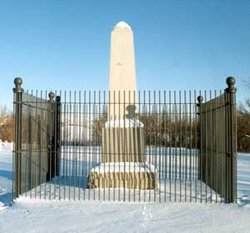
This monument was erected by the Knight family near the mouth of the Niobrara and serves as a memorial for all the Saints who died at the Ponca camp


. 
Newell’s wife Cynthia dies at 2 AM on 24th of January.[64]  Cause of death is
not given in the Holbrook journal, but several died during the month of January of lung problems, possibly pneumonia or complications from the fire.

  The dead included Newel Knight, a stalwart and early friend to Joseph Smith.  Scurvy also caused some of the deaths, making a total of 23 mortalities that winter.[65]  Cynthia also may have been in a weakened condition from short rations and/or complications from her September childbirth.  There was room for bitterness here, toward the Indians who most likely started the lung-damaging prairie fire in their hunting practices, or toward George Miller and the leaders who brought them to this out-of-the-way place, but hopefully Newell did not harbor these feelings.  In any case, he did not abandon his faith, as evidenced by his continuing choices to follow Brigham Young and the Twelve westward.
Her death left Newell grieving with two young children, Lucy, age 2, and Cynthia Remina, age 4 months, who at that age would have needed a wet nurse or to go through what was probably a difficult transition to cow’s milk or goat’s milk.  It is probable that he relied on his mother, Patience or his sister Sarah Drake Paine (mother of  two surviving children and six months pregnant[66]) to help with childcare—Cynthia’s family was not present at the Ponca camp.[67]  Both of Newell’s girls were probably too young to even remember their mother at all.

31 Jan 1847

“Many of our brethren are low in spirits, not knowing what they should do this coming season.”[87]  The livestock were dying, and in early February several men had resorted to hunting and eating wolves.

6 Feb 1847

Apostle Ezra Taft Benson, Lorenzo Snow and Orrin Porter Rockwell arrive at the fort.  Charged with teaching the Saints “The Word and Will of the Lord”, which later was codified as Section 136 of the Doctrine and Covenants (the only section given to Brigham Young), they explained how the pioneers were to be organized and how the westward movement would occur, also a call to greater righteousness.  The revelation in hindsight seems very sensible, but it still managed to raise the ire of George Miller who disagreed with certain points, probably that the Saints would be under the exclusive direction of the Twelve, or possibly that some would be planting crops and building homes near the Missouri for a second wave of pioneers to winter at Winter Quarters (he wanted to move west as quickly as possible), or possibly that they were still going to go west at all, Texas[68] also seeming a viable option.  He had returned from Winter Quarters a few days earlier, had already heard the revelation, and was probably still harboring some heated feelings about the whole thing. 

When the messengers returned to Winter Quarters a few days later, they reorganized the High Council,[69] essentially relieving George Miller of his duties.  Miller went with them and was soon disfellowshipped, following another apostate, Lyman Wight, to Texas.

End of March 1847

The Camp receives word from the brethren to come on back to the Bluffs,[70] echoing advice that Ezra T. Benson had already given them.  Besides the deaths that had already occurred and the lack of supplies,  frankly, it was just too dangerous for one settlement to be so far from the main body of Saints, particularly on the south border of the warring Sioux, where any offense might bring down wrath upon the entire body of Mormon settlements.[71]  Miraculously, no major mishaps of this variety occurred.

April 10

The Saints at the Ponca camp leave for Winter Quarters.  They leave their fort with cabins, outbuildings, etc., in tact, supposing that the Poncas might have use for them, but that night at camp three miles away they saw the flames of its destruction.  The blaze was attributed to Sioux warriors, quick to destroy any asset given to their enemy the Ponca.[90]  Subsequently, the exact site of the fort remains undetermined;[91] hopefully in years to come additional archaeological effort will bring it to light.

By mid-late April the main body of Ponca Saints reached the vicinity of Council Bluffs, where they dispersed among the many camps, including one on the Nebraska side which they also named the Ponca camp[72]  Their journey south was not along the river (also, nowhere does it say they went by boat, which would have been difficult with all the livestock, etc.) had them nearly out of food.  Joseph Holbrook, having gone ahead to do some trading, met the group along the way back.  “Found my family all well, almost out of bread stuff of every description, and so was the camp in general.  We were hailed with joy because we had some cornmeal for them….yet in all our tribulations, we felt joyful.”[88]  No doubt many of them were relieved to be united with the majority and also to have survived such a precarious winter.


Westward and Onward

At this point, for some reason, Newell parts company with his parents and brothers.  Daniel Sr., Patience, Horace and Orson had an enjoyable journey[73] across the plains with the Daniel Spencer Company, arriving in September of 1847, just two months after Brigham Young had declared the Salt Lake Valley “the right place”.  Money does not seem to be a determining factor--both Newell and his father Daniel traveled with multiple wagons.[74]  Might the delay have been a simple case of family situation?  This doesn’t seem to be a strong enough case for delay, though, as little Cynthia would have been several months old when her grandparents and uncles departed.
.
Also staying behind was Newell’s sister Sarah Drake Paine.  She had delivered a son in April of the 1847, about the same time her parents and brothers would have been leaving. (The genealogy indicates the baby was born back in La Harpe[75], but this is very unlikely because Sarah’s obituary says she crossed into Iowa at the expulsion of Nauvoo in 1846.[76])  Whether or not Sarah’s baby was the reason for these two siblings to wait and then travel together a year after their parents is not known, but in any case, Newell and his brother-in-law William Grant Paine are recorded as traveling together on The Trail by 1848.[77]
The most likely scenario for delay is that Newell was obeying the prophet.   The Word and Will of the Lord had specified that some of the families were to stay behind along the Missouri to raise crops and prepare for more of the Saints to take refuge there the following year.  Likely Newell was chosen out from his parents and brothers to stay and help.  It would be helpful to access any records from this fairly chaotic period in church history to see if we could find out what really transpired.

Somewhat surprisingly, Newell did not bring his toddler Cynthia Remina with him on the journey to Utah a year later in 1848, only his older daughter Lucy.  He must have been overwhelmed without a wife, and this arrangement was probably much for baby Cynthia's own good and safety.  The separation was long; Cynthia did not come to Utah until 1856, with her Johnson grandfather and 13 year old aunt Sarah Johnson, when she was 9 years old.[92]  She did rejoin the her father, sister Lucy, new stepmother and several new siblings, showing as present in Newell's household for the 1860 Federal Census.[93]  Counting Cynthia and Lucy, Newell eventually became the father of 14 children.[97]

Newell's journey across the plains to Utah and his subsequent settling in Weber Co. belongs to another chapter.  (For a well-put-together source on Newell's life in Ogden, including another fort he helped to build, please visit www.binghamsfort.org.)  There is one incident I would like to mention to contrast with his Ponca winter.  Newell was part of the Brigham Young company of 1848, along with his sister Sarah and brother-in-law William Grant Paine.[94]  At one point in the journey, the very crowded company was moving very laboriously.  Another Captain Miller, Daniel Miller, Capt.of Fifty, convinced a small group of wagons to buck Brigham Young's stay-together orders and venture out ahead of the rest of the company.  They hoped for streamlined travel and better grazing, despite heated protests from the other captains, including the argument that Miller would be absconding with a much-needed blacksmith and that "the rase is not to the Swift".[95]

That evening Miller's ten, including Newell and William Grant Paine, simply didn't stop when everyone else wanted to stop, and they arrived in Utah a few days ahead of the group.  Despite this need-for-speed rebellion, Miller and his men were so kind as to send back their rested teams to help the main body, and mercifully, Brigham Young remained on good terms with several in the group for the rest of his life, even calling Captain Miller to bring another company of Saints a few years later.[96]  It is surprising that Newell would take such a risk after all the friction with leadership he had witnessed at the Ponca camp--how quickly we forget!  This isolated rebellion is the reason why on some records Newell is listed in the Brigham Young company, and others, in the Daniel Miller company.


Choosing to Follow

To truly appreciate Newell’s pioneer legacy, it’s interesting to point out alternative choices he could have made that would have completely changed the direction of this family’s history.  And he could have easily chosen differently.  He wasn’t exactly surrounded by apostasy, but he was certainly, literally, rubbing elbows with it, as we have seen.  I don’t know what exactly kept him on course, but I am sure he was influenced by the Spirit, by his loyalty to his parents and siblings who forged on ahead, possibly by hard experience, and also by Erastus Bingham and others who were righteous and courageous in the face of controversy. 

Let's review some of the odds against him.
  1. In 1847 Newell had only been a member of the church for six years. 
  2. As far as I can tell, he did not receive what would have been a spiritually fortifying endowment at the frantically constructed Nauvoo Temple.[78] 
  3. He had an elder sister who never did join the church, who probably missed her family and may have welcomed him.
  4. He had grandparents and cousins back east who also probably would have made a place for him. 
  5. Another interesting possible detour for Newell could have been his in-laws.  Cynthia’s father did eventually come to Utah years later[79] bringing Newell’s little daughter Cynthia, but died in California.  I don’t know why he went to California—it could have been for an honorable reason—but it also could have been a falling-out.  Likewise, not wanting to color this the wrong way since there is so little evidence of the-rest-of-the-story, but Cynthia’s mother and several other members of her family did not come to Utah at all, even though they were members of the church.  They turned their wagons south to Texas and there they died.[80]  Although I know absolutely nothing of their particular circumstances, Texas is where at least one apostate group of Saints went to settle, including George Miller.
  6. Newell and his brother-in-law strayed a bit from the company rules, indirectly defying Brigham Young themselves for a short time.  Once your toes are wet...
  7. Being a member of the Church of Jesus Christ of Latter-Day Saints was difficult.  It took huge sacrifice, hard work, courage and grit to brave the mobs, start over again and again, follow direction even through disagreement or discouragement, suffer physical hardships and even death.  Newell could have given up at any time.  Instead, he endured.
After Newell had been in Utah for more than ten years, he received a patriarchal blessing by John Smith, church patriarch.  The blessing, surprisingly, tells him to look to the future.  It mentions that he has been through much change and many trials and would receive his reward.  Also to recognize the Lord's hand because his life had been spared many times for a wise purpose.  It encourages him to work hard and seek wisdom with his remaining years.  Also that "the angel of His presence shall watch over thee, and give thee counsel in time of need, and make thee equal unto every test, and thy posterity shall be numerous and hear thy name in honorable remembrance."  Newell died ten years later in 1879.[98]

Monday, April 21, 2014

Two Silver Pistols and a Blacksnake Whip: Daniel Newell Drake, Part one

There's a bit of glamour that attaches itself forever to a lawman. 

I don't know that my great-great-grandpa, Daniel Newell Drake (1853-1931) would have considered himself a romantic figure, but he really was!  He was an iconic Westerner, right in the thick of history.  He was a farmer.  A miner.  A Mormon (who chewed tobacco).  A politician. A pretty fair singer.  A bodyguard.  A ditch-rider.  Son of pioneers.  A cannery field man.  Railroad builder.  Would be Indian-fighter.  A horseman.  Rock-hauler.  Road supervisor.  Father of 12 children.  Carried peppermints.  Played the harmonica.  He always put on his hat first thing, and it was the last thing he took off at night.

He was one tough hombre.
Daniel Newell Drake (1853-1931)

Because writing about Grandpa Drake is so fun, and also because I'd like to do a little more research, I'm going to split this story into two parts, his private and then his public life.  Here is my connection.  Me, Dad, Jack Drake Haynes, Pearl Drake Haynes, Daniel Newell Drake.

First of all, I'm a little hazy on how to refer to him.  His Dad was also named Daniel Newell Drake.  His Grandfather was Daniel Newell Drake also, and from the pioneer accounts, it sounds as if at least one of these fellas went by "Newell", not sure which one, probably his Dad as he shows up as "Newell" in the 1860 census.  He also had a son Daniel Newell Drake, (brother to my Gr. Grandma Pearl) but on FamilySearch, this one is referred to as "the third" instead of the fourth, (by my calculations).  In the newspapers sometimes this son is referred to as Daniel Drake, Jr., as is his father.  So, since he is the first Drake patriarch of my line, for the purpose of this article I'm just going to call him Daniel, Grandpa Drake, or even Sheriff Drake, which is a little more fun and will not leave any room for confusion.  Where were we?

He was one tough hombre.
And he was definitely not alone.  Grandpa Drake was the eldest son, 2nd of his mother Hannah's 12 children, his father also had two daughters by first wife, Cynthia.  (Cynthia died before crossing the plains, near Winter Quarters, Nebraska.  Hannah married Daniel's father two years later--it was not a polygamous marriage.)  Daniel's parents divorced in 1875 after about 25 years of marriage.  His mother Hannah took the younger boys to Oregon.  His father remained in Ogden, eventually coming under the care of his household until he died four years later in 1879. Some of Daniel's brothers remained in the Ogden area, inheriting the Drake homestead together, but Daniel eventually bought out their portion as they didn't want to farm.  It's unclear how advanced of an education he would have had, probably a normal amount for someone of his time and station before he settled down.

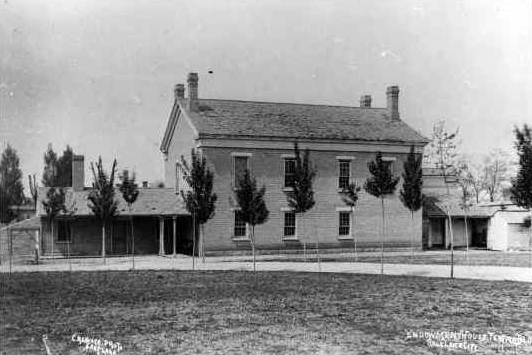
"The Endowment House was used primarily for performing 
temple ordinances. From 1857 to 1876 the baptismal font was
 used to perform 134,053 baptisms for the dead. Between 1855
 and 1884 54,170 persons received their washings and anointings 
and endowments. Between 1855 and 1889 68,767 couples were
 sealed in marriage—31,052 for the living and 37,715 for the dead.
Mormons did not consider the Endowment House a temple, 
so they did not perform all temple ordinances in it. Brigham 
Young explained, “We can, at the present time [1874], go
 into the Endowment House and be baptized for our dead,
 receive our washings and anointings, etc. ... We also have the
 privilege of sealing women to men without a Temple ... 
but when we come to other sealing ordinances, ordinances
 pertaining to the holy Priesthood, to connect the chain
 of the Priesthood from father Adam until now, by sealing
 children to their parents, being sealed for our forefathers,
 etc., they cannot be done without a temple”.[1] Hence,
 there were no sealing of children nor endowments
 for the dead performed in the Endowment House. These
 ordinances were first administered in Utah’s first 
temple, in St. George, in 1877.  The Endowment House was 
also used for other purposes, including prayer circles,  
settings apart, and instructing missionaries before their 
departure, as well as meetings of the various church leaders,
 such as the First Presidency and
 Quorum of the Twelve Apostles." from Wikipedia "Endowment
 House"
Daniel Newell Drake married Mary Jane Cheney (who must have been pretty tough, herself, 12 kids again!!) They met and then married in Weber County (FamilySearch says in Hooper, UT) in 1874.  Daniel was 21, Mary Jane was 17.  The two were sealed in the Salt Lake Endowment House seven years later in 1881.  (It appears that their first four boys, born before this, were later sealed to their parents in 1940, see explanation in sidebar.)  Their daughter Pearl said, "When my dad and Mother were married they used boxes to sit on.  I have the rolling pin that my mother had when she was first married that my Dad had made out of a piece of oak wood.  I still have it and use it, it is quite old.  [Who has this now?]  They were real poor when they first got married.  They were both raised in North Ogden and I don't know where they met." 

I don't know if having 12 children kept him tender or made him even tougher, although it probably did both.  He had nine sons and 3 daughters. He lost one son, Lawrence, at the age of three in 1883, and two more children in 1888, Lucy age six and William age eleven months.  He also outlived his youngest son Ernest Emery, who died at age 18. 
Here is a picture of most of the Drake family by the time Mary Ann was done having children.  Grandpa Drake is in the middle with the great mustache.   The labels for Ira and Emery need to be switched.   (Thanks to cousin Glenna for the photograph.)

Sheriff Drake's daughter Pearl had plenty to share about her father.  He showed his romantic side the first moment he laid eyes on her, naming her "Pearl" because she was "pretty as a pearl!"
Let's let her tell us all about Sheriff Drake as a husband and a father.

(From "My Parents--Daniel Newel and Mary Jane Cheney Drake" by Pearl Drake Haynes, recorded by Ortell Drake Wilson, Sept. 1982).
"My Dad never pulled my hair. [I wonder what kind of question elicited that response!] He was kind of rough talking, he'd scare you.  One night Ira and I wanted to go up by the old store in Wilson Lane.  Mother said, 'yes, you can go,' so we went.  We were up there playing with some friends and all at once, here come dad.  He had a rope and he tried to lasso us but I out-run him.  He caught Ira and tied him around the neck and led him home.  I ran home and
my sis [Rose] was having a boyfriend in the parlor.  I ran in there and got behind what they called a folding bed.  I stayed in there until about eleven o'clock and my Dad was sitting out in the living room waiting for me.  I could see his legs through a crack in the door.  He had about four or five big switches lined up against the house.  I saw them as I ran in and I though, 'Oh, poor Ira's going to get it' because he caught him but he didn't spank him.  He sent Ira to bed and sat there until eleven o'clock and then he said, 'Well, you can come out and go to bed'.  He didn't whip me.  But my sister would have whipped me pretty good.  She tried to get me out from behind that folding bed because she had her boyfriend with her.
 "My Dad used to chew tobacco which I didn't like very much but he was clean about it.  Mother would make him take the cuspidor out and clean it every day or two.  She wouldn't allow him to keep it in the house very long....
 "I remember when he got his patriarchal blessing when the oldest boys were young.  One of them, when Mother was out doing chores and father wasn't home, got the scissors and cut his blessing all up.  So they went to the church and got a copy.  I have a copy of his and Mother's.  I remember going to church with my Dad when I was a child.  He always went to sacrament meeting and the women sat on one side of the room and the men sat on the other.  I'd always go and sit with him because he had peppermints in his pocket.  The rest of the children sat with Mother.  I think I heard him pray once in church when I was a kid.  Mother said he used to go to church real good and never used tobacco but he worked in the mines, the Bingham Mines, and he used tobacco because the coal dust was so bad.  Their lungs would fill up and they were told to keep something in their mouths so he used tobacco.  That's how he got started using it. 

"He was in the hospital before he died and my sister-in-law told me this.  (I hadn't seen my father for three years.)  He begged for just a little piece of tobacco and she wouldn't give it to him.  He said, "They won't even give me a drink of water and I've got to have something to wet my throat down."  She said, "Well, Dad, I'll go out and get you a tiny rock and you can suck on that."  And she did.  They took him home in a day or two.  My brother, Lewis, said it took three of them to hold him down in bed before he died.  He was out of his head.  They said before he went to the hospital, they found him down on the canal bank trying to turn the water in.  He was a Ditch-Rider at one time.  They got there just in time or he would have flooded the whole place out.  He had kidney trouble and was 79 years old when he died.
"I was sick a lot.  I had ear trouble from three to fourteen, a gathered ear.  My dad would sit up nights with me, with my earache.  Sometimes he'd heat up a little bit of pinch of tobacco and put it in and I'd keep it warm and that would ease it.  He was awful good to help with the children.  He'd hold me on his lap and put me in bed with them at the foot of the bed.
"We had a lot of fun.  Every summer we went camping.  We'd go and stay all night or maybe two or three days up in Ogden Canyon.  We had a covered wagon and cooked outside.  The boys made a tent over the wagon tongue and Mother and Dad, I , and the two younger boys slept in the wagon.  Rose stayed home
part of the time to tend the house.  One particular time we were up Sheep Creek.  A big storm came up.  It thundered and lightninged and just poured.  Mother was so frightened; she had Ira and Emery and I just like this, just a-choking us.  My brother, Jack, was with us at that time.  The horses got loose and went down the canyon.  There we were, stranded with no horses.  A man camped up above us said lighting had struck that place twice and when we pulled in there, he worried about us when the storm came up.  He took the men down the canyon and caught the horses.  It rained so hard, even the older boys had to get in the wagon.  Water was running all over the camp.  It was awful!
"My Father loved to fish and he loved horse races.  He always had nice horses and saddles.  We did a lot of riding.  I loved horses from the time I could stick on one.  My father taught me how to ride and drive and how to hitch up my own horse.  In the mornings we would catch the fish and go fry them.  We'd have hotcakes and fish, eggs, and bacon.  When we were up in the mountains Dad took me fishing.  One day we went out on a big rock in the river.  'Now you sit right still or you'll fall off'.  I fell off all right!  So, I had to go back to camp so he could catch some more fish for us.  He was good to me.
"He used to sing 'Old Dan Tucker'.  Every morning when he'd get up, he'd get up with his hat on and come out singing, 'Old Dan Tucker, came too late for his supper.
[Check out this audio clip by Jim Smoak, found on Wikipedia, pretty fun to imagine.  I'm sure Grandpa Drake loved that his name was also "Dan", haha.]
 "I said to Mother, 'Does he always sleep with his hat on?'  She said, 'No, he puts it under the bed and that's the first thing he puts on when he gets up.'  Oh, dear, such stories.  Mother and Dad always loved to read the newspaper around the table at night.  She'd be sitting knitting and all at once, they'd break out into a song.  They'd sing together.  I used to sit and listen, it was beautiful.  Dad and Mother could sing "A Poor Wayfaring Man of Grief" straight through, all the verses.  Dad loved to sing, just for himself and Mother.  We had an old organ but nobody knew how to play it.  They got it when I was about ten but I never learned.  My Dad played pretty tunes on the mouth organ.  He always saw that every boy had a mouth organ for Christmas.  My brothers had a band in Wilson Lane, drums.  Lewis played the bass drum.  Jack and Clarence played the snare drum in a drum corp and they played for different occasions.  Some of the boys in the ward played horns and one played a fiddle.  I remember Mother telling about that.  In fact, I knew about the drum corp because I must have been about eight or nine when they had it.  [Daniel's uncle, Horace Drake, also a Utah pioneer, made drums and musical instruments, had been a drum major in the Nauvoo legion, and it would be interesting to know if he influenced these boys since he didn't pass away until 1918 in Davis county, Utah.]
"Dad was never mean to me.  He used to put on a big front.  My kids were scared to death of him but he would never hurt one of his grandchildren.  He loved them all.  When Glen and Irene [Pearl's eldest son, and a niece]  were little, they would go in the separator room and turn the separator.  He'd just yell at them and they'd go out the window.  You'd think my Dad was rough but he wasn't.
"I think we only had seventeen acres when I was a child.  My grandfather, as I understand, homesteaded where the sugar factory was.  He divided that land with his boys, was the story I got.  My Dad and Uncle Nate were the only ones who stayed there, on the Wilson Lane homestead.  Uncle Nate got tired of farming so he sold out to my father.  My parents raised 12 children at that home.  They never moved from Wilson Lane.  We raised sugar beets, tomatoes, and had a large orchard.  I had to pick lots of apples, prunes, and everything.  Watermelons, canteloupes.  My Dad pedaled watermelons to Coleville, Utah, you know.

One Christmas I'll never forget.  Dad put our stockings up behind the stove.  In the morning, there was coal in the bottoms and a stick of wood in the tops.  Of course, we all cried...Santa Claus passed us by.  Dad came out singing "Old Dan Tucker" and said, "Santa Claus thought you were too mean.  He left a stick to whip you with."  So after he got the fire going and all this, he said, "Go on in the parlor and see if he happened to go in there."  We went in and heavens!  There was a saddle for Charlie and I had a new doll buggy and a doll and I can't remember what Ira got.  He had something nice but our santa Claus was all in there.  He was quite a joker when he wanted to be but he was stern, when he told you anything to do, you had to go.  We'd be working in the field and he would send I and Ira after water.  He'd say, 'Now I want you to get that water from the bottom of the well and I don't want it warm when it gets here!'  Of course, you know kids.  We just poked along.  When we got to him, he took a sip and just dumped it all on our heads.  'Go back and get some cold water.'
"I rode the horse to cultivate and my Dad carried little rocks in his pocket.  When he said, 'Gee,', he meant 'Gee' and if you didn't go 'Gee' you got a rock.  If he said 'Haw' and that horse didn't go to the left, you got another little rock.  I hoed beets, I picked tomatoes, I helped haul lots of peas to the factory.  I mixed bread when I had to stand on a stool to do it.  I did housework from the time I was a little kid.  I was in a play one time and my Dad took the little stool the cookie jar was on.  I was to mix bread in the play; I was just a little bit of a thing, and I stood on the stool and made my bread right there on the program, a nice, little roll of bread."
My Grandpa Jack Drake Haynes only saw Grandpa Drake once--in his coffin.  Nevertheless, I think he held him in high regard and I suspect that his love of all things John Wayne has a little bit to do with his Grandpa's legacy.  He related two of his favorite stories about Grandpa Drake.

First of all, he said that although Grandpa Drake was a lawman, etc., his biggest difficulty was his son Charlie.  Charlie would go off to do his chores but instead of coming home when he was finished, he would go into town and hang out at the pool halls and other places he shouldn't have been.  Finally, Grandpa Drake had had it.  He stripped Charlie naked, put him on the horse, and sent him off to bring in the cows.  "He'll come home this time!"  My family also has a video of Pearl retelling this story on her 95th birthday, and I can just see the shame and sympathy on her face, "Oh, Dad, he doesn't have any clothes!"  (I think she considered it a pretty harsh measure.)  Anyway, the plan didn't work.  Charlie brought back the cows, snuck into the house, retrieved his clothes, and was off again.

Although there might have been some tough love for his sons, Daniel had a tender place for his daughters.  This is Jack's favorite story about his Grandpa Drake, and it has to do with Pearl herself.  (She didn't include this particular story in her memoir--I don't know how she felt about it.)
Blacksnake whip.  Typically 6-12 feet in length.  Has a heavy
 shot load in the handle to facilitate its use as a club.


There was a one-armed schoolmaster who was rather cruel and beat the kids regularly, including Ira, maybe some of the other Drake boys.  One day this teacher beat Pearl--Jack thinks she might have been around 7th grade.  Jack says Grandpa Drake was the Weber County Sheriff at the time.  Well, when Sheriff Drake heard about this latest beating, he got on his horse and waited out in front of the store because he knew that the teacher always picked up his mail at a certain time.  (Let's say noon!)  Sure enough, when the teacher came along, Sheriff Drake "tuned him up with his blacksnake whip right there in the street."  He declared that the teacher might whip the boys once in a while--they might need it--but if he ever touched his daughter again he'd kill him. "And he never got off his horse!"  


Monday, September 30, 2013

The General in the Orchard: Samuel E. Hartzell

I know I promised that I would be posting soon about George Washington.  Well, that story is going to be a little work to condense and I will get to it eventually.  In the meantime, I stumbled across another account that might surprise you.  With another famous General.

Robert E. Lee.

The Heagy/Hartzell/Giffin side of the family centers in Adams (formerly York) county Pennsylvania.
County seat:  Gettysburg.  (In Cumberland township--the blue section on the following map.)
Last year I found a lovely 1858 map of Adams County Pennsylvania that labeled the actual homes of landowner ancestors Samuel Hartzell and David Heagy Sr. (Samuel Hartzell and David Heagy Sr. are the fathers of Ann Hartzell and David A. Heagy (Jr.) who married before the war began.  David and Ann Hartzell Heagy are the great-grandparents of my grandpa, Ebert Heagy.) They are located  northwest and north of town as "S. Hartzell" and "D. Hagey."   Well, of course I immediately checked the Gettysburg National Park maps to see how their home locations compared with the battlefield.  They don't really match up; the battle being more southwest of town.  So, I didn't think much more about it and moved on to other projects.

However, just recently while researching someone else, I did come across some amazing info on Samuel Hartzell and the two Heagy Davids, records that shed a pretty bright light on this infamous place and time in history and how our family was affected.  (The Heagy account will be covered in a companion article someday soon.)

Note:  I'm tickled that this is also my second story for Storyapples that takes place in an apple orchard!

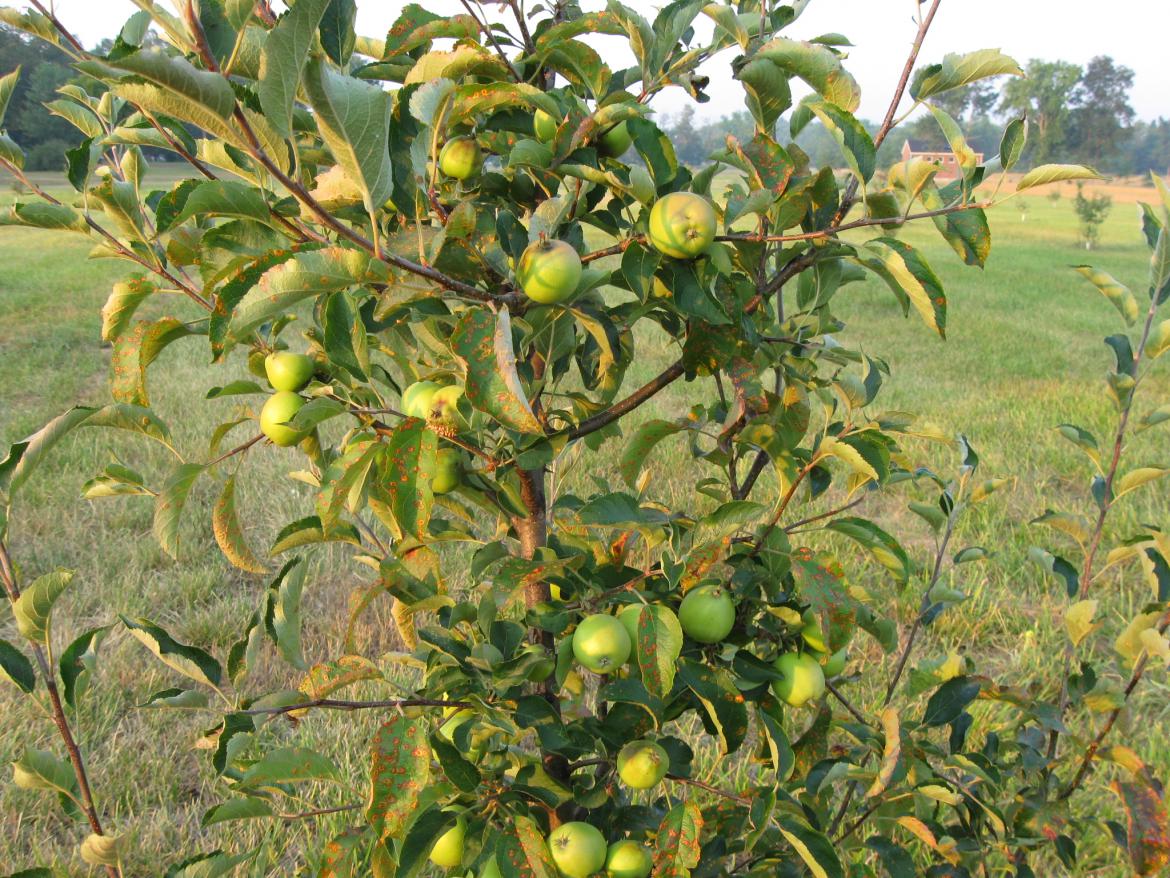
 This picture shows a replanted apple orchard in 2010 that, according to the blog GettysburgDaily.com,  "in July of 1863 was owned by a farmer named Samuel Hartzell."  If their claim is true, the orchard did not immediately border Samuel's home (at least, if he stayed in the same home as in 1858).  Instead, this orchard is just south of the Chambersburg Pike, one of the main roads into Gettysburg.  (on the map, it's to the west of town, just under the dotted line railroad.  The orchard would have lain somewhere just south of the Thompson homes, if I'm understanding the story correctly). 
This picture, also from GettysburgDaily.com, was taken July 6th--one of the days of the Battle of Gettysburg--so the apple crop would have looked about like this (but the trees were probably more mature).
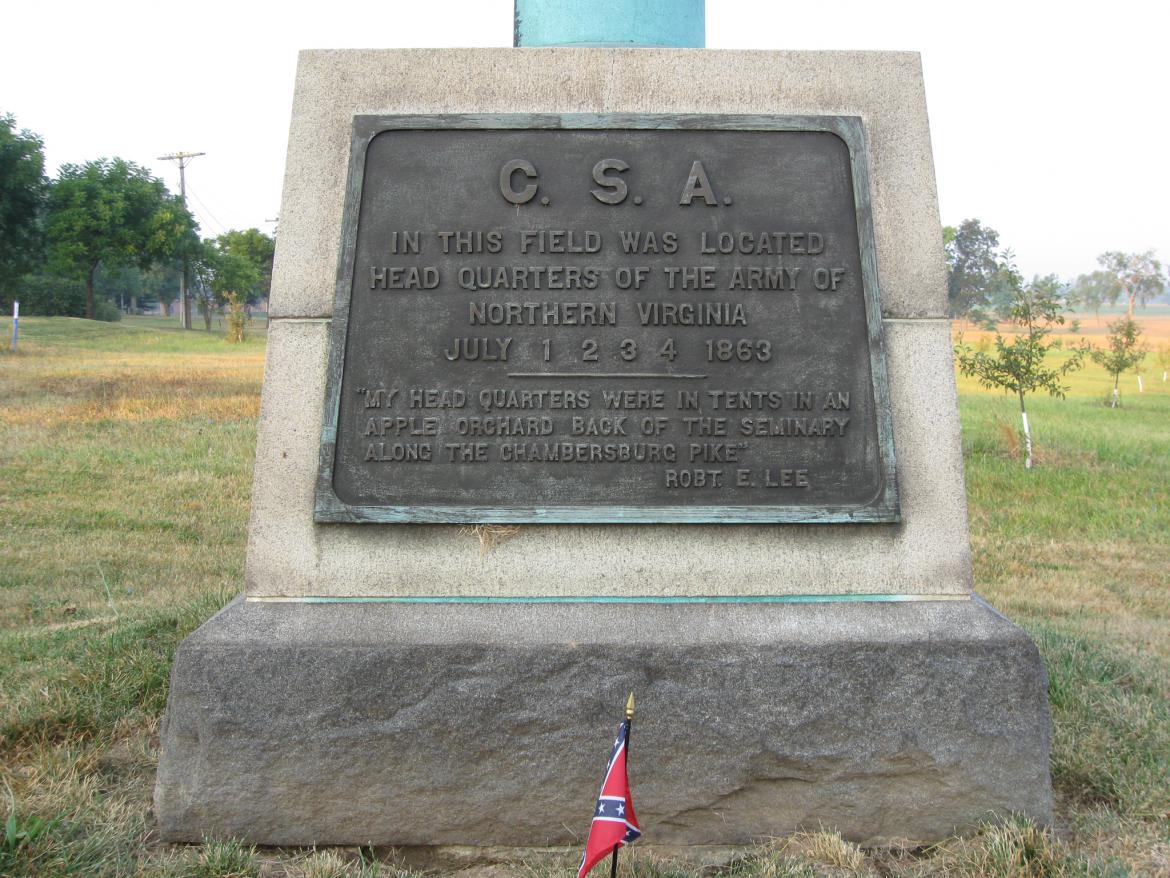
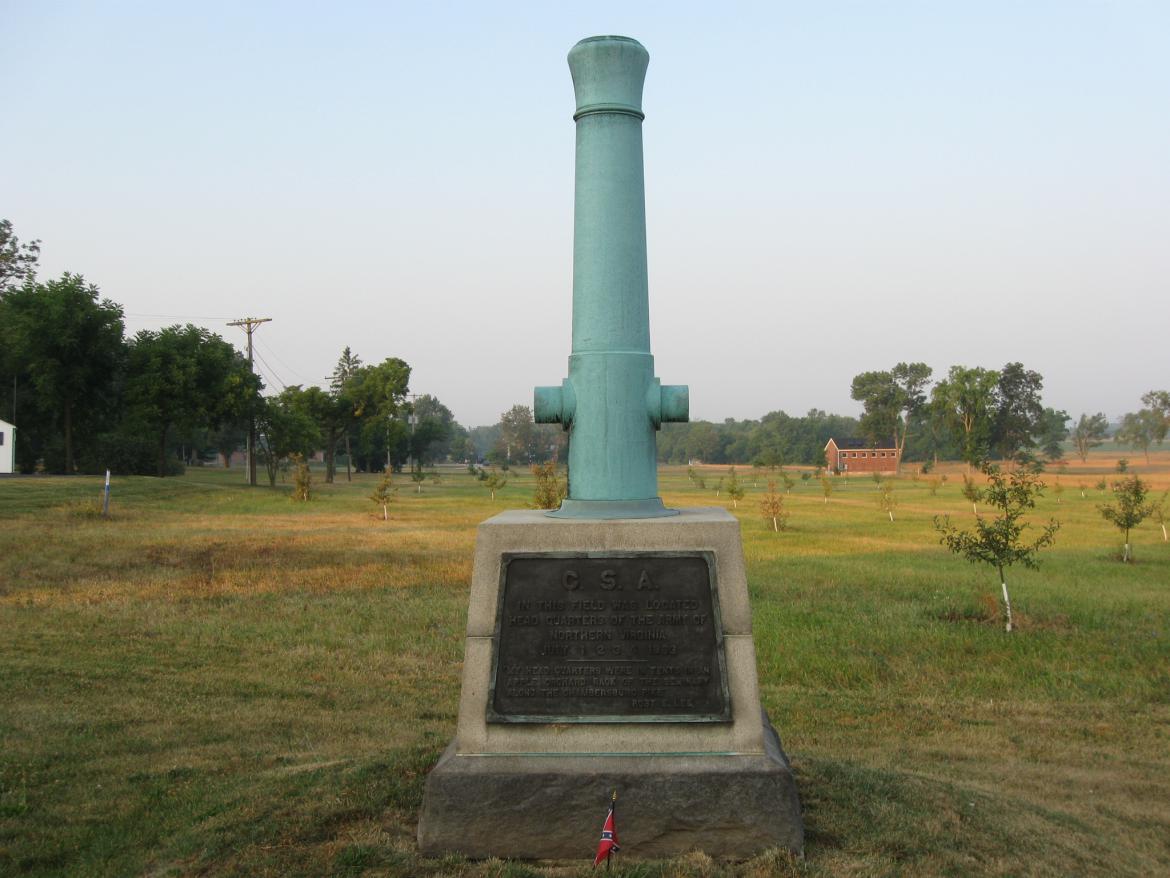
 So, what's so interesting about this particular orchard, owned by Samuel Hartzell (age about 49) in 1863?  Well, if you were to visit this orchard today (and man, do I wish I could go someday), this is what you would see.
Disclaimer:  The GettysburgDaily.com article says that this quote by Robert E. Lee may be bogus, but historians are pretty sure that the location is right, anyway.  Also, remember, this is and was an apple orchard, not the famous "Peach Orchard" battle site.  There were several orchards in the area.

The brick building in the background is the seminary building belonging to "Seminary Ridge."  This picture is facing south.
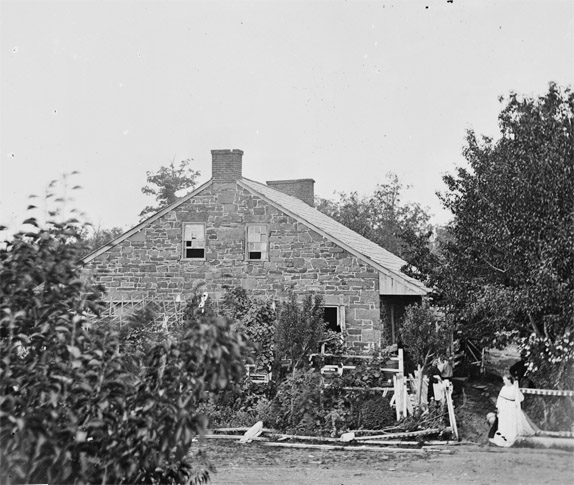
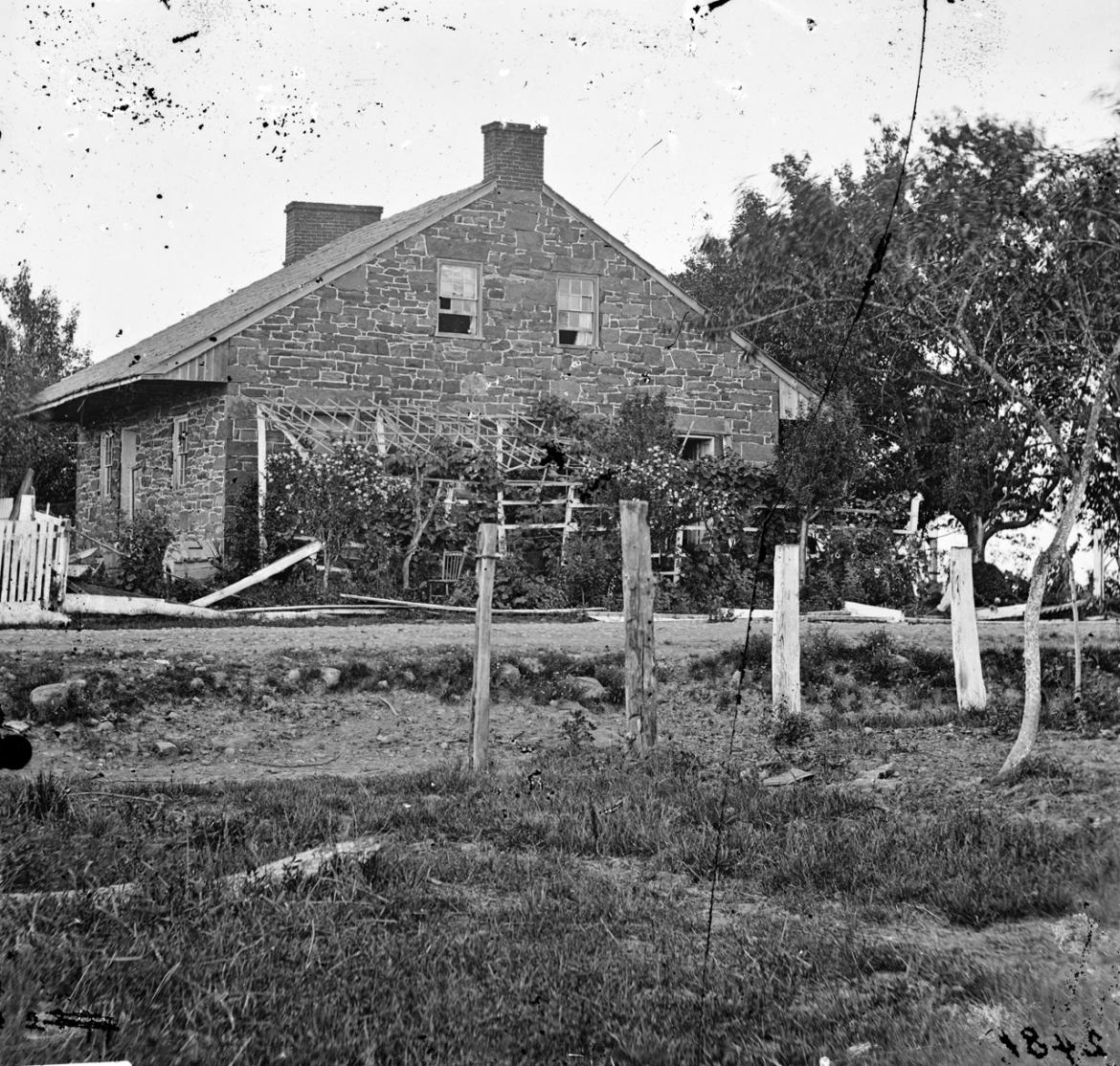
This is the Thompson house just north and of and across the road from the orchard.  (The tree in the foreground is part of the orchard).  This picture was taken sometime around the battle, July 1863, by famous Civil War photographer Matthew Brady.  This house is still standing and serves as a museum/bed and breakfast as "Lee's Headquarters" since Lee purportedly slept and ate here.  Notice those knocked down fences?  We're getting to that.
The Battle of Gettysburg was fought the first few days of July 1863.  About 165,000 soldiers had converged around this little town, with about 50,000 casualties, the highest number of casualties for a single battle in the war.  (Luckily for my family, there was only a single civilian casualty).  It was also a major turning point for the Union.  The war moved on, and the poor townsfolk were left with the destruction, a really big cemetery, and a visit from Pres. Lincoln.  Recovery must have been a huge endeavor.  No FEMA to call in 1863!

Or was there?


Not in 1863.  And definitely not from the extremely busy Federal Government.  But it turns out, in1868,(three years after the war was over and five years after the Battle of Gettysburg) the great State of Pennsylvania began to pass a series of acts designed to recompense civilians who sustained damages to property and goods during the war.  In other words, some help came in the form of dollar signs, even if it was slightly delayed.

Nothing improves people's memory like a promise of some cold hard cash!  Claimants could come to court, tell a bit of their story, leave an inventory of damages and their best estimate of how much they thought they should get.  They also brought witnesses to sign affadavits, etc.  Lucky for us, Ancestry.com has digitized these court records and we can find out what happened to Samuel Hartzell during the Battle of Gettysburg.

The petition of Samuel Hartzell, declares that he was a resident of Cumberland Township (includes Gettysburg) in 1863 and that "he sustained loss and damage in his property...the amount of damage sustained...which he prays may be allowed to him as follows, viz:"  then Samuel gives his statement.

"That the Rebel Army occupied my farm for two or three days, that during that time they took from me the following property, viz:
One wagon & bed worth $70
A Skep of Bees
13 Sheep " 45.50
3 Heiffers " 54
1 Scap of Bees " 10 [a "skep" of bees is a traditional straw beehive, as pictured.]
3 Hogs " 24
2 Scythes & Cradles " 8
3 Tern(?) of Hay " 30
4 Sett Horse Gears " 30
Corn & Oats in Barn " 14
829 Rails " 66.32
2 Colts 16 months old " 100
35 Acres grass destroyed " 150
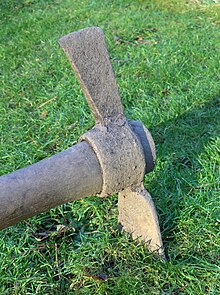
2 Shovels and Mattock " 3.24
Mattock
also his meadows and fields were damaged to the amount of $25.00
 
Samuel was awarded $605.10, not quite the full $630 because the court ruled "The damage to meadows and fields as claimed ...is disallowed."

I wish that Samuel would have told a little more of what he was doing on those days, but he did have two witnesses give depositions to support his claim, and from there the picture becomes a little livelier.  One witness was next door neighbor David Schriver.  Mr. Schriver is on our map, so I am sure that Samuel was in fact living in the same house in 1863 as in 1858.  Mr. Schriver stated to the court that: "he lives on the adjoining farm to Samuel Hartzell, that about the beginning of July part of the rebel Army occupied the farm of Samuel Hartzell.  I was acquainted with the property mentioned in the appraisement and know that it was on the farm before the Rebels came and that it was not there after they left.  I saw the Rebels on his farm and know that his Rails were destroyed & the grass of his meadows destroyed.  I saw them burn the Rails.  I put out the fire near the Barn, and that the appraisement made of the property destroyed & taken is not too much."
22 Oct 1868
David Schriver

I thought the "is not too much" was kind of a thoughtful phrase.  I also wondered about the money for the fences.  Did the fence belong solely to Samuel?  Or would he have split the cost with his neighbors?  Apparently not.  I would assume that the rails were burned for firewood, but the fact that the neighbor had to put out a fire near the barn makes me wonder if the soldiers were just being destructive.  Did you notice those rails removed and scattered on the ground in the picture of the stone house?  Those would have been across the road from his orchard, but I'm assuming the soldiers did the same thing to his property.  Here is another picture by Matthew Brady of that same property.  This time, taken from deeper inside Samuel's orchard.  Notice, these were probably some of the missing rails that he counted in his inventory.  I think it's interesting that the soldiers left the posts.  They must have been buried well.
Another view of the Thompson house, taken from Samuel Hartzell's orchard (Lee's headquarters).

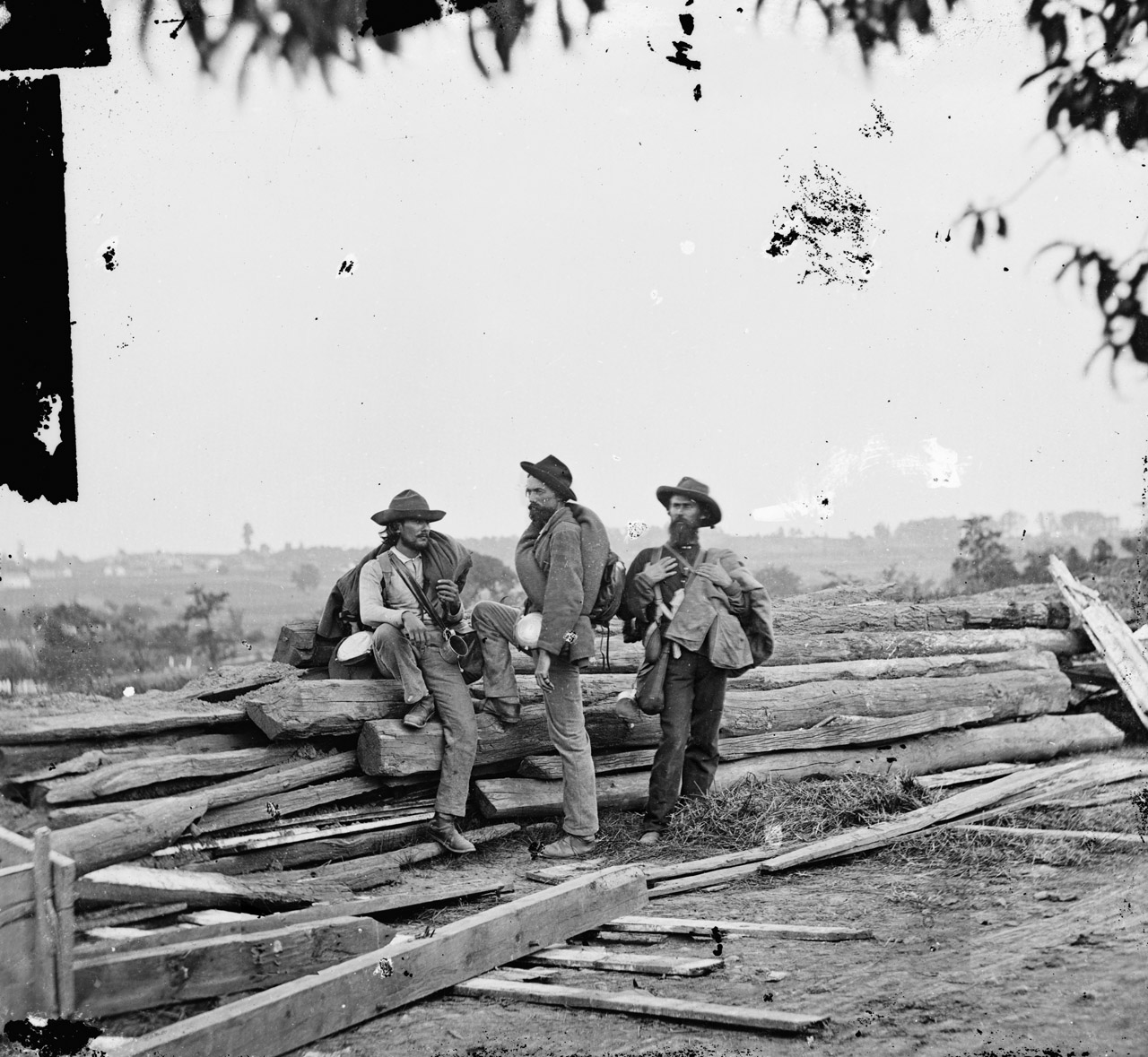
This picture, also by Matthew Brady, is one of the most famous shots of the Gettysburg aftermath--I actually have seen this one before, probably in textbooks or on Ken Burns' The Civil War.  The subjects are three Rebel prisoners.  Notice what the ramparts they are sitting on are made of?  Logs and fence rails!  Guess where this picture is taken.  Yup.  Right outside of Grandpa Hartzell's orchard, overlooking Seminary Ridge.
According to the list of damages, the fence rails weren't worth all that much, but for some reason they seem like the heart of this story.  Think of all that work!  As a farmer's daughter, I can picture the farmer going out to assess the damage after a bad hailstorm, estimating acres destroyed and dollars lost.  Samuel did just that.  His friend William Allison also swore before the court "That [Samuel] & John Hamilton shortly after the battle examined the farm & made an appraisement of the Damages.  That they found the Rails destroyed & 35 acres of grass destroyed and the fields injured as above mentioned".  I imagine Samuel walking his fenceline with his friend and counting the missing rails, one by one.

Portrait of Samuel and either his second wife Eliza or his 3rd wife Elizabeth.
All things considered, the battle could have been much worse for him.  His family was safe.  His house was still standing (and his neighbor saved his barn from burning, although it sounds like there wasn't much left to put in it!).  His son-in-law David Heagy was soldiering elsewhere and probably saw less actual warfare than Samuel did.  His eldest daughter Ann, although extremely pregnant during the battle with Samuel's first grandson and living without her husband but with one small daughter, was able to take refuge with friends of the family and safely deliver my great-great grandfather a couple of weeks later.

Samuel did lose a son, Elias Hartzell, age 23, in 1865, nearly two years after the Battle of Gettysburg, but I haven't yet researched if Elias was a casualty of war.
 
I also double checked my battle info on Wikipedia and found this battle map that explains why even though most of the well-known sites of the Gettysburg battle were south of town, as is the State Park, in real life, the enemy soldiers completely surrounded the Hartzell and Heagy properties northwest of town (as well as the apple orchard), and that there was actual fighting in that area the first day of the battle.  That surprised me.  I guess I always pictured the Southern forces attacking from, I don't know, the South?  Rebels shown here in red, Union in blue.


I noticed that there was no mention of destruction to the apple trees on Samuel's claim, and the trees in the photographs looked fine.  It's too bad--I was hoping someone down South owed me a pie.

If you would like to read the two articles about Lee's headquarters by GettysburgDaily.com, they are found here.
part one
part two


Tuesday, August 13, 2013

It All Adds Up: Harry Raymond Haynes

Looking over some family pictures with Happy Jack Haynes last week, I heard a new story/character trait about his dad, Harry Raymond (Roy) Haynes.  Jack said that his dad loved math and was talented at figuring in his head.  (I wonder if he would have been a math major if he had gone to college?  Maybe not, maybe business...  Jack has also said that Harry loved selling.)  Anyway, every time Harry went to the grocery store he liked to keep an exact running total in his head of everything they were buying.  This blows my mind!  It was a little game of his to see if he had made an accurate count when the clerk rang everything up.  I wonder how he would do with my full cart of groceries, including price-matched items at WalMart?  Jack said that one time Harry took my Dad, Scott, shopping with him when Scott was a schoolboy.  Harry challenged Scott to keep track of the total.  He did it!  (Maybe there weren't many things in the cart, Dad?...just kidding.)  Perhaps we don't push our own children enough with real life math skills.

Jack also said (years ago on a video) that Harry would always carry around a little "indelible pencil".  I imagine this was his math accessory.

Thursday, July 4, 2013

They that be with Us are More...

They that be with Us are More...

In our old house we had a vivid red hallway that I filled up with black and white portraits.  Beneath the picture frames, in black script lettering, read the words "Fear not; for they that be with us are more than they that be with them. 2 Kings 6:16"  If you don't remember that particular Bible story, it was when Elisha the prophet had irritated the king of Syria by warning the king of Israel about Syria's battle tactics.  The Syrian king was angry and sent a host of soldiers to encompass Elisha's city, intending to hunt him down and kill him.  In the morning, when Elisha's servant went out early, he saw the terrible army and cried, "Alas, my master! how shall we do?"

Elisha reassured him.  "Fear not: for they that be with us are more than they that be with them."  Then Elisha prayed for the Lord to open his servant's eyes, and the young man saw the reality of the situation.

The two men of God were not alone on their mountain.

"Behold, the mountain was full of horses and chariots of fire round about Elisha."  He was not afraid because he knew that he was watched over and loved by those on the other side of the veil.  And because there were more of them than of the adversary.

Bess Kale
I chose that quote because the portraits on that very red wall were some of our ancestors, including my mom and dad's newspaper wedding announcement (back when my Dad had a seventies 'stache and some great sideburns), a cute picture of my father-in-law as a child hiding inside his dad's mailbag, and a shy profile of my great-grandma Bess, who, according to my Dad's cousin Sheila, was a crier just like me.  Of course, Bess lost her teenage twin sister to leukemia, two babies to disease, and a toddler in a horrible accident, so I don't know what my excuse is.

I also had a no-nonsense picture of Mark's namesake Grandpa Newel Day, but I later learned that I had used the "wrong" one.  More on that in a minute.

The whole idea for putting the portraits on the wall with that scripture was to remind our family that there are people cheering for them, both here and on the other side.  Turns out I was one step ahead of the national media.  Recently (February?) USA Today published a study that proved that the number one influence for successful, resilient teenagers was not the number of books in the home, or the education level of the parents.  Surprisingly, the magic ingredient was that the teens had a strong sense of family identity and heritage.  If they knew who they were, and that their family could "do hard things" and still make it through, they tended to thrive even in difficult circumstances.  In this scary-wicked world, I want my kids to know what is expected of them, but also that they are loved and that they can make it, too.

It's not only teenagers that can gain this kind of strength from those that have gone before... I noticed that with our experiences over the past year with having a high-risk heart baby, and having him go through some life threatening (and life giving) surgeries, I've been thinking/reading/understanding more about death and such serious topics than I usually would.  Like thinking about how everyday it used to be for women to die in childbirth or babies to not live to their first birthday.  How did my Grandmothers do it?--those poor women.  Many of these thoughts culminated while I taught a class for the ladies at church the Sunday before Luke's scary surgery.  It was Mother's day, and I should have been an emotional worried mess, but instead, teaching about some of this deep stuff calmed me and helped me focus on reality.  The lesson was about eternal family relationships, of all things.  I told the ladies about my Grandpa Happy Jack.

My Grandpa Happy Jack likes to write cowboy poetry.  Really awful stuff.  Once in a while, though, he has some really great lines.  My personal favorite (I'm not biased or anything) was a poem he wrote when Mark came up to Montana over Christmas break to meet my parents for the first time.  I think it was called, "The Sodbuster's Daughter", and the best line he ever wrote was "What makes a man go North in Winter?"  Just last month he shared another zinger that was read at Duke and Natalie's wedding dinner, it was "The Duke and Duchess of Green River."  Everyone laughed.  So what makes great poetry, then?

I still remember at my Grandma LaVonne's funeral, my Uncle Gib was delivering the eulogy (because he was probably the only one who could do it without crying).  He did a great job, but he made everyone else cry.  He read a poem that Grandpa had written in his anguish.  I only heard it once.  The beginning line nearly made everyone gasp.

"Who turned out the lights?"

As tears rolled down our cheeks, we listened to how Grandpa, in this poem and in his sorrow, was able to make it.  Even though he wasn't the one reading the poem, in my mind's eye he says this very deliberately, even pointing his finger.

"You made me a promise at that altar, Lord." 

I don't remember the rest, but all these years, that one line, one truth, is what I took away.  Now, isn't that what makes a poet great?

Grandpa Jack got his strength to go forward from his covenants with God.  So do I.


I love that our church teaches that our souls are eternal.  We lived with our Heavenly Father in heaven before we came to earth.  He loved us so much that to help us learn and have a chance to feel a fraction of HIS love, he placed us here in families, intentionally.  "And because he loved thy fathers, therefore he chose their seed after them" --Deuteronomy 4:37.  After the resurrection we can be with our families again, forever.  That was the promise that Jack and LaVonne received at the altar of the temple--that they would be married for time AND all eternity.  Life's a three-act play, you know?  And we can only see the middle.  And the middle is extremely short compared to the rest!

I once heard at a wedding, somewhat shockingly, that our life here is like the width of a piece of paper.  (The bishop marrying the couple actually held up a blank sheet of paper and showed us the edge.)  He taught, correctly, that marriages that are "til death do you part" really are only for that long.  Don't you want to be with your loved ones for the eternities? (The bishop described an invisible thread wrapping around the earth more times than you could ever count, as opposed to that skinny piece of paper.)

Take a tour of a newly built or renovated temple sometime if you can, before it is dedicated.  They are an "architectural realization of the Sinai experience."  The marriage rooms are beautiful, especially their opposite-wall mirrors that show you what it might be like to be never-ending.  The covenants we make there are "for time and all Eternity" and include binding our children to us for that long as well.  Remembering my covenants was a huge, huge strength and comfort to me as we considered the possibility of losing our Luke.  It makes me so sad to think of all those mamas throughout the centuries that were told that their babies were going to hell.  Nonsense, cruel nonsense.  It also makes me sad to think of all the mamas (and often Dads) in our secular culture who deep down in their souls yearn for that eternal connection but don't know how to get it, so they make some outward demonstration like tattooing the names of their children into their very skin.

Last night as we were drifting off to sleep I asked Mark what he thought of first, when he thought about the people that had already died that were waiting to greet us on the other side.  I expected him to say something about his Mom, who passed away when Leslie was a baby.  He remembers her often and feels her influence. However, after he thought about my question for a minute, his response was not what I was expecting.

He said, "Isn't it great that there is a push and a pull?"  Huh?  He explained that our children push us.  They look to our example and help us remember that they will be like us someday.  They aren't easy--they push us to be better than we normally would, through serving and loving them.  The pull comes from those that have gone on before.  They want us to honor their names and live the kind of lives that will make us happy and that will help us be with them again someday.  We are the binding link of the chain of hearts of fathers and children (Malachi 4:6).

Mark is reminded of the push and pull every time he signs his name.  He is named after his paternal grandfather, Newel Day.  Grandpa Day always used to ask him, "What are you doing with my name?"  We named Luke after this same grandpa and hope he will feel that pull someday, both from Grandpa Newel and from Mark.  Remember how I said I had used the wrong picture of Grandpa Newel on my wall?  I liked the one I used just fine, but I later found out that Grandpa preferred a different picture of himself during his lifetime.  A picture exists where he is standing among palm trees, his arms outstretched, young and smiling.
"Take a good look." he used to tell his children and grandchildren "This is the way I will look when you see me in heaven."

They that be with us are more.

Wednesday, June 26, 2013

Kiss-Up Ann Saves the Day...

It's exciting to "meet" new ancestors, especially ones that have left some clues about what they were like. In trying to discover the parents of my GGGGrandmother Ann Giffin Heagy from Gettysburg, I came across two Giffin wills in her hometown, newly digitized and available on familysearch.org. These wills enabled some large growth in our known family tree.

The first will, dated 1794 was by a Stephen Giffin, Sr., and he mentions mentions a wife and daughter, both named Ann. Hooray!  Until I realized that the daughter would have been way too old to be my Ann.  Also, the daughter Ann never married or had children.   The will also included a Stephen Giffin (Jr.), and his son, Andrew.  Andrew is a buzzword here, since our Ann named her son David Andrew, and the David part would have been after her husband David Sr.  Are you confused yet?

To clarify, we now have three Anns near Gettysburg, where before we only had one.
1.  Matriarch Ann (insert maiden name) Giffin, wife of the will writing Stephen Sr.
2.  Ann the "Maiden Aunt" Giffin, daughter of #1.
3.  Annie Giffin Heagy, who until now was the end of the line.  Now all I had to do was connect her to the others.
For my own brain, I've had to assign these Anns some nicknames because, I didn't mention before, I keep getting Annie Giffin Heagy mixed up with:
4.  Hoopskirt Ann:  Ann E. Hartzel Heagy, who married Annie Giffin's son David Andrew.
5.  Second Wife Ann:  Annie Meritt Heagy, who married David Andrew after #4 passed away.
 I'll tell you about Ann #3's nickname in a minute.
Hoopskirt Ann

Second Wife Ann, not blood related


David Andrew Heagy, son of Ann Giffin Heagy, husband to Ann Hartzel and Ann Meritt. And very handsome.

The second will turned out to be by that unmarried, maiden aunt Ann, who lived to a ripe old age.  (Maiden Aunt is the polite way to say Old Maid).  In the will she leaves several items to one Ann Giffin, daughter of Andrew Giffin of Gettysburg "for her services and attention to me and my sister Elizabeth".  She also left young Ann the house, with a gentle condition "I do hereby desire the said the same Ann Giffin continuing to take care of me and my sister Elizabeth during our lives."  Bam!  This caretaker Ann Giffin is the right age, in the right place at the right time to be our Ann Giffin (as supported by the 1810, 1820, 1830 Census).  She would have been the great niece of Auntie Ann, and also the great granddaughter of Stephen Sr. who wrote the will.  In my mind I have been irreverently calling my Ann Kiss-Up Ann, because she was taking care of her rich Auntie.  I don't know, if I were her, I might have played up the fact that I was Auntie's sweet and dutiful namesake.

The whole situation reminds me of Jo in Little Women reading to her cranky old Aunt Josephine, hoping for some financial support and perhaps an inheritance.  In any case, her descendants are very lucky that Kiss Up Ann did her duty, because it prompted Auntie Ann to record the relationship in her will and gave me a boost up over that research brick wall.

So, to guide you up the tree, we are related as follows:
Me>Mom>Grandpa Heagy>Charles Aaron Samuel Heagy>Charles Heagy>David Andrew Heagy>Ann Giffin>Andrew Giffin>Stephen Giffin, Jr.>Stephen Giffin, Sr.

More on this new branch later...George Washington will be making an appearance.